
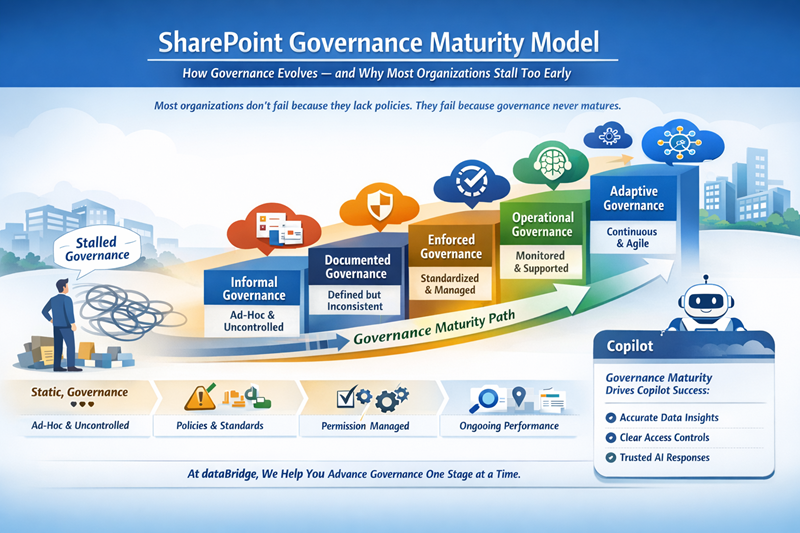
SharePoint Governance Maturity Model Guide
SharePoint succeeds or fails based on its foundation. Without clear architecture and governance, even well-intentioned deployments quickly become disorganized, difficult to manage, and frustrating for users. At dataBridge, we help organizations design SharePoint architectures and governance models that support scale, security, adoption, and long-term value.
Helpful Links
Without governance enforcement built into structure and process, even the best governance plans fail — because humans won’t follow documents, they follow consequences.
SharePoint Governance Maturity Model Guide
How Governance Evolves — and Why Most Organizations Stall Too Early
Most organizations don’t fail at SharePoint governance because they lack policies.
They fail because governance never matures.
Early governance efforts often start with good intentions — defining rules, assigning owners, and documenting standards. However, without a clear maturity path, governance stalls. It becomes static while the platform, the business, and tools like Copilot continue to evolve.
At dataBridge, we use a governance maturity model to help organizations understand where they are today, what risks exist at each stage, and how to move forward without over-engineering or bureaucracy.
This guide breaks down what governance maturity actually looks like — and how to progress deliberately.
What Is a SharePoint Governance Maturity Model?
A SharePoint governance maturity model describes how governance evolves from informal, reactive decisions into a structured operating model that scales with the organization.
Rather than treating governance as a one-time project, the model recognizes governance as a living system — reinforced through structure, process, and behavior.
A mature governance model aligns:
- Decision ownership
- Policies and standards
- Day-to-day operating rhythms
- Ongoing feedback from real usage
Without maturity, governance exists on paper. With maturity, governance shapes behavior by default.
The Five Stages of SharePoint Governance Maturity
Informal Governance
At this stage, governance is mostly implied.
Decisions are made by whoever speaks up first. Standards may exist, but they aren’t enforced. Ownership is unclear, and exceptions are common.
Typical signs include:
- Inconsistent site structures
- Ad-hoc permissions
- Users creating workarounds outside SharePoint
This stage often feels “flexible,” but it introduces long-term risk — especially around governance and compliance controls
Documented Governance
Organizations at this stage begin formalizing governance.
Policies are written. Roles are defined. Standards are published. However, enforcement still relies on awareness rather than structure.
While this is progress, governance often struggles because teams don’t fully understand governance roles vs responsibilities.
Governance exists — but adoption is inconsistent.
Enforced Governance
At this stage, governance moves from documentation to design.
Standards are enforced through:
- Site provisioning processes
- Permission models
- Information architecture decisions
Governance is no longer optional because the platform supports it by default. This is where SharePoint governance frameworks begin to hold up under scale.
Organizations here see reduced sprawl and improved consistency — but governance may still be reactive rather than adaptive.
Operational Governance
Operational governance introduces rhythm.
Governance is reviewed regularly, reinforced through support, and connected to real platform activity like migrations and new workloads.
This stage is where governance readiness for Copilot becomes possible, because structure, ownership, and permissions are predictable.
Governance decisions are no longer one-off events — they are part of how the organization operates SharePoint day to day.
Adaptive Governance
Adaptive governance is the highest maturity level — and the rarest.
Here, governance evolves continuously based on:
- Usage patterns
- Organizational change
- Platform updates
- AI adoption
Feedback loops connect:
into a single governance system.
Governance doesn’t slow the organization down — it enables confident change.
Why Governance Maturity Matters More Than Governance Volume
Adding more rules does not improve governance maturity.
In fact, overly complex governance models often collapse under their own weight. Mature governance is not about control — it’s about clarity.
A well-designed governance maturity model comparison reveals that successful organizations focus less on policy volume and more on:
- Decision clarity
- Structural enforcement
- Ongoing reinforcement
This is why governance maturity directly impacts adoption, security posture, and AI outcomes.
How Governance Maturity Affects Copilot Outcomes
Copilot does not create new information — it surfaces what already exists.
If governance maturity is low:
- Copilot retrieves inconsistent or outdated content
- Permissions are unclear, increasing risk
- Users lose trust in AI responses
As governance maturity increases, Copilot benefits from:
- Consistent structure and metadata
- Clear ownership and lifecycle management
- Predictable access controls
This is why governance readiness for Copilot is not a licensing decision — it’s a maturity decision.
Moving Forward Without Over-Engineering Governance
One of the biggest governance mistakes organizations make is jumping straight to “best practices” without understanding their current maturity.
Progressing through governance maturity should be:
- Intentional
- Incremental
- Aligned to business priorities
At dataBridge, we focus on advancing governance one stage at a time — reinforcing what exists before introducing complexity.
The goal is not perfect governance.
The goal is governance that works.
The dataBridge Perspective
After years of SharePoint consulting one pattern is consistent:
Organizations with mature governance don’t spend less time on SharePoint — they spend less time fixing SharePoint.
A strong governance maturity model creates stability, trust, and confidence. It ensures SharePoint can evolve with the business — and that tools like Copilot amplify value instead of exposing risk.

THE SEARCH IS OVER
We're a Microsoft SharePoint partner - everything you need IS right here
For more information about how dataBridge can transform your business with improved corporate communication, collaboration, forms, workflows, and document management, contact us today.