
SharePoint Migration Consulting Services
dataBridge provides SharePoint migration consulting that helps organizations plan what should move, how content should be structured, how permissions and ownership should be handled, and how Microsoft 365 should function after go-live. We treat migration as a business and architecture effort, not only a technical file transfer.
A SharePoint migration should improve the environment, not recreate old problems in a new platform. That requires decisions about architecture, metadata, permissions, governance, adoption, and cleanup before migration waves begin. This page explains how dataBridge helps organizations modernize intentionally and reduce long-term rework.
Working with SharePoint migration consultants
The hard part of a SharePoint migration is deciding what should move and who owns it afterward. The file copy is the easy part. We start every engagement with a SharePoint migration readiness assessment so the plan is built on what is actually in your environment, which keeps old permissions and redundant content from riding along into the new tenant.
SharePoint migration consulting helps organizations move documents, workflows, and collaboration environments into SharePoint Online while improving information architecture, governance, permissions, and long-term Microsoft 365 usability.
Written by Michael Fuchs, Founder and CEO of dataBridge. Reviewed by Alek Dov, Senior Migration Specialist, for SharePoint migration planning, Microsoft 365 cloud modernization, migration risk reduction, and technical migration accuracy.
Published: January 25, 2026
Last reviewed: August 18, 2026
Structured SharePoint Migration Consulting for Real Business Results
If your organization needs a secure, predictable move to SharePoint Online, our SharePoint migration consulting and SharePoint migration services help you plan, protect, and perform with confidence. We guide complex migrations by prioritizing governance first — because structure always beats shortcuts.
For a practical planning resource, review our SharePoint Migration Checklist for Microsoft 365 to see the decisions that should be made before migration waves begin.
Trusted by IT leaders to reduce risk, resolve permissions sprawl, and deliver predictable outcomes.
At dataBridge, our SharePoint Consulting Services help organizations migrate to SharePoint and Microsoft 365 in a way that actually improves how people work. Instead of recreating yesterday’s problems in a new platform, we design migrations that clean up content, reduce risk, and prepare your environment for tools like Microsoft Copilot.
Successful migrations rarely stand alone. Many organizations combine migration planning with SharePoint governance, information architecture and metadata, and broader SharePoint and Microsoft 365 consulting solutions so the new environment does not recreate legacy problems in a newer interface.
What This Looks Like in Practice
A company may begin by asking how long it will take to move documents into SharePoint. Once discovery starts, the larger issue often becomes clear: source content is fragmented, folders have no clear owners, permissions are inconsistent, duplicate files exist across departments, and no one agrees which content is still useful.
That same discovery usually reshapes the budget, so it helps to know what a SharePoint migration costs before scope is locked.
In that situation, dataBridge does not recommend a straight lift-and-shift. We help define what should move, what should be archived, what should be restructured, and what should be excluded before migration waves begin. We also help design the destination architecture so SharePoint supports better search, cleaner ownership, stronger governance, and long-term adoption.
The improvement is a migration that creates a better Microsoft 365 environment, not a cloud version of the same old file share. Teams get clearer scope, fewer avoidable surprises, better validation steps, and a stronger post-migration governance path.
For a related client example, the SharePoint Document Migration and Field Mobility Solution for Solar Energy Provider case study shows how dataBridge helped migrate more than 10TB of business-critical documents, design a scalable SharePoint architecture, introduce taxonomy, improve search, and support field access to job information.
This work often connects to the SharePoint Migration Readiness Assessment, the SharePoint Migration Checklist for Microsoft 365, the File Share to SharePoint Migration Readiness Matrix, and the SharePoint Post-Migration Checklist.
What Does a SharePoint Migration Consultant Do?
A SharePoint migration consultant helps organizations plan and execute migrations that improve the structure, governance, and long-term usability of their Microsoft 365 environment. Rather than simply moving files from one system to another, experienced consultants analyze information architecture, permissions, metadata, and collaboration patterns to ensure the new SharePoint environment supports secure document management, reliable search, and scalable collaboration.
During a migration, consultants help organizations identify redundant or outdated content, restructure document libraries, align permissions with governance policies, and prepare the environment for emerging capabilities such as Microsoft Copilot. Not every inactive site or older content collection needs to be deleted before or after migration. Some content is better handled through a defined Microsoft 365 Archive for SharePoint approach that keeps historical material available while reducing noise in active workspaces. This strategic approach ensures the migration improves the overall health of the Microsoft 365 platform rather than simply relocating existing problems.
Table of Contents
What Is SharePoint Migration Consulting?
SharePoint migration consulting is a structured partnership focused on moving your content, permissions, and business logic to a modern, governed Microsoft 365 environment. In our experience, migrations fail not because of tools — but because strategy, structure, and people were ignored.
We don’t just automate moves. We evaluate content quality, information architecture, and security posture so that your data arrives ready to be managed, found, and trusted.
Organizations that approach migration as a simple file transfer often recreate the same structural problems in the new environment. Many of the most common issues—from duplicate content to broken permissions—are discussed in detail in this guide on SharePoint migration mistakes, which highlights the pitfalls organizations should address before beginning a migration project.
Work With a SharePoint Migration Consultant Who Prioritizes Structure
When organizations search for a SharePoint migration consultant, they are not looking for a migration tool. They are looking for experience, judgment, and strategic oversight.
At dataBridge, our SharePoint migration consulting approach is led by senior architects who understand that migrations rarely fail at the technical layer — they fail at the decision layer. Permissions complexity, governance gaps, and unclear ownership models create long-term problems if not addressed before content moves.
In our experience, successful SharePoint Online migrations require more than automation. They require structured planning, phased validation, and disciplined security alignment. That is why we focus on strategy first — ensuring your SharePoint migration strategy supports long-term platform health, not just short-term cutover.
- Direct access to experienced SharePoint migration consultants
- Architecture-first planning that reduces post-migration remediation
- Governance alignment before execution
- Phased migration waves with validation checkpoints
- Clear accountability for security and ownership
The result is a controlled, defensible migration that strengthens your Microsoft 365 environment instead of simply relocating its problems.
When organizations search for a SharePoint migration consultant, they’re not looking for software. They’re looking for judgment.
Read the ReVision Energy migration case study to see how dataBridge consolidated more than 10TB of content, introduced enterprise taxonomy, and improved field access for installers.
SharePoint Migration Services Built for Predictable Success
- Pre-Migration Assessment – Identify risk, compliance gaps, and migration blockers before execution.
- Content & Permissions Rationalization – Reduce clutter, tighten access controls, and prepare structured content models.
- Phased SharePoint Online Migrations – Break complex moves into manageable, validated waves.
- Governance & Ownership Alignment – Define who owns what, so your environment stays healthy post-migration.
- Post-Migration Health & Optimization – Validate permissions, optimize search quality, and lock in adoption gains.
These SharePoint migration services reflect our experience delivering dozens of enterprise migrations across manufacturing, healthcare, finance, and education.
SharePoint Online Migrations That Align With Business Outcomes
Moving to the cloud should be strategic — not just technical. SharePoint Online migrations consolidate legacy data, unify content models, and eliminate risk through structure. We’ve migrated terabytes of content and untangled overly-permissive estates with repeatable, staged approaches that minimize business disruption.
Rather than generic scripts, we design migration waves that map to real business units, security policies, and compliance requirements. This real-world strategy dramatically reduces rework and content reconciliation after cutover.
A SharePoint migration is not a file move
- Content cleanup
- Information architecture redesign
- Permissions rationalization
- Adoption readiness
Why SharePoint Migrations Often Fail
Most SharePoint migrations do not fail because files cannot be moved. They fail because the new environment inherits old structure, unclear ownership, broken permissions, duplicate content, and weak governance.
Common risk patterns include:
- Migrating everything “as-is” without cleanup
- Carrying forward broken permissions and oversharing
- Recreating folder sprawl instead of modern structure
- Ignoring metadata, ownership, and governance
- Treating migration as a one-time IT task
For a deeper breakdown of these patterns, use Why Most SharePoint Migrations Fail. This page stays focused on how dataBridge helps plan and deliver the migration consulting engagement.
To prevent file share sprawl from becoming SharePoint sprawl, use the File Share to SharePoint Migration Readiness Matrix before migration planning is finalized.
The Cost of a Poor SharePoint Migration
A poorly planned SharePoint migration rarely fails immediately. In many cases, the environment appears functional at first—files are accessible, libraries exist, and teams begin working in the new system.
The real problems often emerge months later.
Without a structured migration strategy, organizations frequently carry legacy issues into their new environment. Duplicate content remains scattered across libraries, permissions become difficult to manage, and search results return too many irrelevant files. Over time, users begin to lose confidence in the platform.
These challenges become even more visible as organizations adopt AI-powered tools such as Microsoft Copilot. AI systems rely on the structure and permissions already present in SharePoint. If content is duplicated, poorly organized, or incorrectly secured, Copilot may surface outdated or misleading information.
Common long-term consequences of poorly executed SharePoint migrations include:
- Duplicate or fragmented content across multiple document libraries
- Broken or inconsistent permissions that expose or restrict information incorrectly
- Declining trust in search and document discovery
- Microsoft Copilot surfacing outdated or low-quality content
- Expensive remediation projects required months or years after the migration
For this reason, successful SharePoint migrations focus not only on moving files, but on improving structure. Information architecture, metadata strategy, governance policies, and lifecycle management must be designed during the migration process—not after it.
When these elements are addressed correctly, organizations gain a SharePoint environment that supports reliable collaboration, governance, and future innovation across Microsoft 365.
A Better Way to Think About SharePoint Migration
Instead of asking “How fast can we move our data?”, better questions are:
- What content should actually be migrated?
- How should it be structured going forward?
- Who owns it—and who should have access?
- How will users find and trust information after migration?
- Is the environment ready for AI and automation?
In other words, migration is an opportunity to reset—not just relocate.
That reset works best when a SharePoint Governance Framework is defined before content is moved into the new environment.
Before migration waves begin, the SharePoint governance maturity scorecard can help identify whether ownership, permissions, lifecycle, metadata, records, search, adoption, and support are strong enough to prevent old problems from moving into the new environment.
For more complex migrations, SharePoint migration architecture and governance helps define destination sites, hub relationships, library structure, permissions, metadata, ownership, lifecycle rules, and cleanup decisions before migration waves begin.
Organizations researching migration strategy, governance planning, and Microsoft 365 architecture in more depth can explore our SharePoint & Microsoft 365 Knowledge Center, which includes detailed guides on migration planning, information architecture, governance frameworks, and Copilot readiness.
Proven SharePoint Migration Strategy That Reduces Risk
A solid SharePoint migration strategy begins with structure, not tools. Our methodology prioritizes discovery, governance alignment, and content lifecycle planning before a single byte moves. Understanding the common SharePoint migration mistakes organizations make can dramatically improve migration outcomes and prevent legacy problems from being recreated in the new environment.
- Discovery & Audit – Map content, permissions, and integrations.
- Architecture Design – Configure secure target models that scale.
- Phased Migration Waves – Migrate in controlled, validated groups.
- Cutover Validation – Confirm access, search quality, and performance.
- Post-Migration Adoption – Enforce governance and sustain results.
In our experience, migrations without strategy leave organizations with permissions sprawl, search confusion, and long-term governance debt. We solve that before migration begins.
Ready to plan a secure, structured migration? Our SharePoint migration specialists help you build a strategy that delivers real business results.
Our Approach to SharePoint Migrations
We take a foundation-first approach to SharePoint migration.
Rather than starting with tools, we start with understanding:
- How your organization works today
- How information flows across teams and departments
- Where security and governance are breaking down
- What success looks like after go-live
Only then do we design the migration plan.
This approach results in a cleaner, more secure SharePoint environment that users actually adopt. Read The Complete Guide to SharePoint Online Migrations
What We Address Before Anything Is Migrated
Before content moves, we help organizations:
Assess and Rationalize Content
Not all content deserves to be migrated.
We help identify:
- What is active, outdated, or redundant
- What should be archived or retired
- What content needs restructuring
As a result, you migrate less content—but higher-quality content.
Organizations that need a starting point often begin with a structured readiness review before finalizing scope, risk, and cleanup decisions.
Design Modern SharePoint Structure
Instead of recreating file shares, we design:
- Logical site architecture
- Purpose-driven document libraries
- Metadata that improves search and Copilot results
This ensures SharePoint works the way it was intended.
Fix Permissions and Security
Migrations often expose years of permission sprawl.
We help:
- Replace individual permissions with role-based access
- Simplify inheritance models
- Reduce security risk before content is widely exposed
This creates predictability and trust.
Align Migration With Governance
Migration without governance is temporary success.
Therefore, we align migrations with:
- Ownership models
- Site lifecycle rules
- Naming and provisioning standards
So the environment stays clean after migration—not just on day one.
Selecting the right partner can determine whether a migration becomes a smooth transition or a prolonged disruption. Experienced consultants approach migrations differently than tool-driven providers by focusing on information architecture, governance, and user adoption before content is moved. If you are comparing providers, our SharePoint Consulting Firm Guide explains how to evaluate expertise, methodology, and long-term support capabilities.
Risk Mitigation Strategies That Actually Work in SharePoint Migrations
Most migration risks don’t come from tooling — they come from assumptions.
Common risks include:
- Moving content without clear ownership
- Preserving broken permissions structures
- Migrating content that no one actively uses
- Introducing new platforms without changing how people work
Effective risk mitigation starts before migration and continues after cutover.
Key strategies include:
Define ownership before content moves
Every site, library, and major content set should have a clearly identified owner responsible for accuracy, access, and lifecycle decisions — a core principle of effective SharePoint governance.
Design structure before migration begins
Information architecture should be validated before content is mapped. Migrating into an undefined or evolving structure guarantees rework later.
Stage migrations in phases
Breaking migrations into logical phases reduces disruption, allows lessons learned to be applied, and limits the blast radius of issues — especially in complex SharePoint migration projects.
Validate search and permissions early
Issues with SharePoint search and discoverability and access control are often discovered too late. Testing these early prevents trust erosion immediately after go-live.
Plan for post-migration support
Migration is not the finish line. Post-migration support and optimization are what determine long-term adoption and success.
Risk mitigation isn’t about avoiding change — it’s about ensuring the change is intentional and sustainable.
When to Choose a Migration Assessment vs. a Full Migration
One of the most common mistakes organizations make is committing to a full SharePoint migration before they understand what they’re actually moving.
A SharePoint migration readiness assessment is the right starting point when:
- You don’t have a clear inventory of content, sites, or permissions
- Ownership of sites and libraries is unclear or outdated
- File shares or legacy platforms have grown organically for years
- You suspect a large portion of content is obsolete, duplicated, or unused
- You’re planning for Copilot readiness and need confidence in content quality and structure
An assessment provides visibility into what exists, what matters, and what should be left behind. It allows organizations to make informed decisions about scope, sequencing, and risk before any content is moved.
A full SharePoint migration makes sense when:
- Information architecture has already been defined or validated
- SharePoint governance and ownership models are established
- Content has been rationalized and approved for migration
- The business is aligned on priorities, timelines, and outcomes
At dataBridge, we often see migrations succeed when assessments are used to reduce scope — not just plan it. Migrating less content, more intentionally, almost always leads to better adoption and lower long-term cost.
Once scope is clearer, use the SharePoint migration planning checklist to turn assessment findings into specific planning decisions for architecture, governance, permissions, testing, communication, and cutover readiness.
What Good Information Architecture Looks Like During a Migration
Information architecture is where most SharePoint migrations quietly succeed or fail.
Good migration architecture is not a mirror of the past. It’s a translation of how the organization works today and how it plans to work tomorrow.
Strong migration-focused information architecture typically includes:
Clear site purpose and boundaries
Sites are created with defined intent — not as catch-all’s. Each site answers the question: Who is this for, and what belongs here?
Libraries designed around use, not departments
Libraries support SharePoint document management by reflecting how content is accessed and used, not how the org chart is structured.
Metadata that supports findability and lifecycle
Metadata is applied selectively to improve search, retention, and Copilot accuracy not added indiscriminately.
Permission models that scale
Permissions are designed to be repeatable and understandable, aligning with long-term SharePoint security and governance practices.
Alignment with governance and Copilot readiness
Architecture supports governance enforcement and ensures Microsoft Copilot for SharePoint surfaces relevant, trustworthy information.
At dataBridge, we approach information architecture as a migration accelerator not a delay. When structure is designed correctly, migration becomes faster, cleaner, and far more resilient.
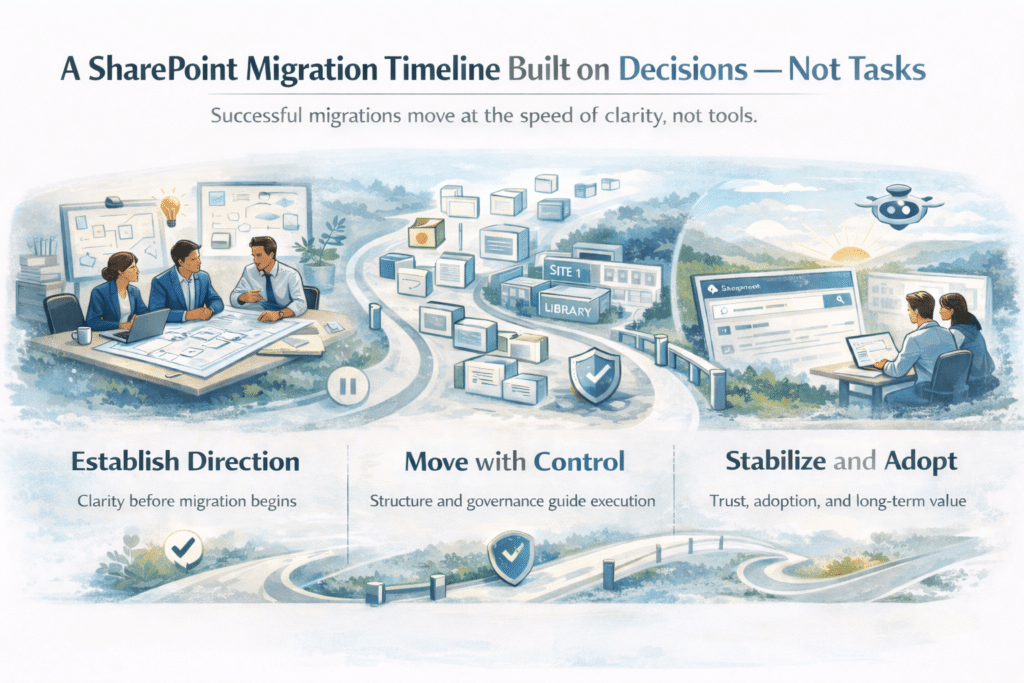
How a SharePoint Migration Timeline Should Actually Work
A common misconception about SharePoint migrations is that the timeline is defined by tools and task lists. In reality, successful migrations are paced by decision readiness, not execution speed.
At dataBridge, we view the migration timeline as a sequence of commitment points — moments where clarity matters more than progress.
Early Phase: Establishing Direction Before Movement
The earliest phase of a migration is not technical. It’s about alignment.
Organizations that rush past SharePoint migration readiness assessment work often discover mid-migration that ownership, structure, and governance were never fully agreed upon. This is where scope expands, timelines slip, and confidence erodes.
When direction is clear early, execution becomes predictable later.
Middle Phase: Moving with Intent, Not Momentum
The middle of a migration is where discipline matters most.
Content moves best when it is mapped into a validated information architecture, governed by clear ownership, and supported by consistent SharePoint governance rules. This phase is less about speed and more about control.
Well-designed migrations often move slower than expected — and finish faster than feared — because rework is minimized and surprises are rare.
Late Phase: Stabilization, Trust, and Adoption
The final phase of a migration is where many projects quietly fail.
A technically “complete” migration is not a successful one if users don’t trust search, permissions feel unpredictable, or content quality is inconsistent. This is why post-migration support and optimization must be part of the timeline, not an afterthought.
For clients who want continued guidance after cutover, the SharePoint Advisory Partnership helps maintain adoption, governance, content quality, and improvement priorities once migration work is complete.
This phase ensures the environment is stable, understandable, and ready to support long-term initiatives like Copilot readiness and ongoing platform evolution.
Why Timeline Discipline Matters More Than Speed
Organizations that treat migrations as races often win the cutover — and lose adoption.
Organizations that treat migrations as decisions supported by execution build platforms that last. A well-paced timeline creates space for governance enforcement, user confidence, and continuous improvement.
At dataBridge, we don’t measure migration success by how fast content moves — we measure it by how confidently the organization operates afterward.
Planning a SharePoint Migration?
Many organizations begin a SharePoint migration expecting the project to focus primarily on moving files. In practice, successful migrations require careful planning across information architecture, permissions, governance, and long-term Microsoft 365 strategy.
An experienced SharePoint migration consultant can help organizations evaluate existing content, identify structural risks, and design a migration approach that improves collaboration rather than simply relocating files. This often includes restructuring document libraries, aligning permissions with governance policies, and preparing the environment for modern capabilities such as Microsoft Copilot.
If your organization is preparing for a SharePoint migration or evaluating migration options, it can be helpful to discuss the environment with an experienced consultant before beginning the project.
Talk with a SharePoint migration consultant →
SharePoint Migration Scenarios We Support
We support migrations from:
- File shares and network drives
- Legacy SharePoint (on-prem or classic)
- Third-party systems (Box, Dropbox, etc.)
- Mergers and acquisitions
- Tenant-to-tenant consolidations
Each scenario has different risks, and we plan accordingly.
The source you are moving from also drives which tool fits, which is why we keep several on hand instead of forcing every job through one – here is how the main SharePoint migration tools compare.
When a merger or divestiture is driving the move, planning a tenant-to-tenant migration around the deal timeline becomes its own discipline – identity, permissions, and two governance models have to be reconciled before the close date, not after.
When the source environment is a shared drive, network drive, or file server, use file share to SharePoint migration services to focus the plan on cleanup, metadata mapping, permission review, validation, and governance before old folder sprawl is copied forward.
When the source is a wiki like Confluence, the job shifts from copying pages to deciding where each one belongs – knowledge base, intranet page, document library, or the archive pile. Our playbook for migrating from Confluence to SharePoint covers what doesn’t transfer and how to scope the move before a deadline locks.
When the source is Google Workspace, the project splits into two tracks: the Drive content and Shared Drive re-architecture we run, and the mail cutover your migration partner or IT team handles in parallel. Our guide to Google Workspace to SharePoint migration explains why Shared Drives don’t map to SharePoint sites and what happens to the Apps Script and Forms layer that can’t be copied.
When the source is Box, the files move easily and the links do not – every shared link anyone ever sent from Box breaks at cutover, and the collaborator roles piled up over years need a deliberate translation into SharePoint’s permission model. Our guide to Box to SharePoint migration covers the shared link inventory, Box Notes conversion, and the coexistence window that keeps the move from becoming a support event.
When the source is Dropbox, the biggest scoping risk sits outside the Dropbox team entirely: personal accounts employees opened years ago that still hold company files. No admin console or migration tool can see them. Our playbook for Dropbox to SharePoint migration covers how to find those accounts before scope is set, along with what happens to shared links and Paper docs.
When the source is an aging SharePoint Server farm, the move is a redesign rather than a database copy, and the July 2026 end-of-support deadline makes the timing real. Our approach to migrating SharePoint Server 2016 and 2019 to SharePoint Online covers what carries over, what has to be rebuilt, and how to plan the cutover before support runs out.
For farms already running past that date, see what changes once SharePoint Server 2016 and 2019 reach end of support and how to move when you are starting late.
SharePoint Migration and Microsoft 365
SharePoint is the backbone of Microsoft 365.
Because of that, migration decisions directly affect:
- Microsoft Teams file organization
- Copilot accuracy and trust
- Power Platform solutions and automation
- Search, compliance, and retention
A poorly planned migration creates downstream problems across the entire platform.
A well-designed migration enables everything else to work better.
There is one assumption worth retiring during the move: landing in Microsoft 365 does not mean your content is backed up. Microsoft keeps the platform running, but recovering your own files after a bad delete or a ransomware hit stays on you. Decide where backup fits before cutover rather than after an incident forces the question – start with what Microsoft 365 backup covers, and what it doesn’t.
Organizations planning modernization initiatives often research migration strategies alongside governance and architecture improvements. These topics are covered throughout our SharePoint & Microsoft 365 Knowledge Center.
Preparing Your Environment for Copilot
Copilot doesn’t fix messy content—it amplifies it.
That’s why migration is one of the most important Copilot readiness steps. During migration, we help ensure:
- Content has clear ownership
- Permissions reflect intent
- Structure supports discovery
- Metadata improves AI responses
As a result, Copilot surfaces insight instead of noise.
For the common case where the content is not even reachable yet, our post answers does Copilot work with file shares and explains what migration changes.
Migration Is Not the End—It’s the Beginning
A successful SharePoint migration isn’t defined by how fast data moves.
It’s defined by what happens after the migration.
When migration is done well:
- Users trust the platform
- Content is easier to find
- Security is predictable
- Adoption increases
- AI delivers better results
That’s the outcome we design for. After go-live, teams often use the SharePoint Post-Migration Checklist to validate permissions, search, governance, and adoption before issues compound.
How dataBridge Helps With SharePoint Migrations
We help organizations:
- Plan migrations strategically
- Clean up content before it moves
- Design modern SharePoint structure
- Simplify security and permissions
- Align migration with governance
- Prepare for Copilot and automation
We don’t just move data—we fix the foundation.
Thinking About a SharePoint Migration?
If your organization is planning a SharePoint migration—or struggling with the results of a past one—now is the time to step back and do it right.
A well-designed migration sets the stage for collaboration, governance, and AI success across Microsoft 365.
Organizations with industry-specific compliance, document management, or collaboration requirements should connect migration planning to SharePoint architecture for regulated industries so retention, auditability, permissions, and controlled-document needs are considered before content moves.
SharePoint Migration Strategy Resources
Organizations planning a SharePoint migration often need more than one resource. Migration success depends on timing, scope, structure, permissions, governance, validation, adoption, and post-go-live support.
Use these migration resources based on where you are in the process:
- The Complete Guide to SharePoint Online Migrations — Full educational guide for planning a structured SharePoint Online migration.
- SharePoint Migration Readiness Assessment — Diagnostic starting point for evaluating scope, cleanup, permissions, ownership, governance gaps, and readiness risk.
- SharePoint Migration Checklist for Microsoft 365 — Practical pre-migration checklist for goals, architecture, governance, permissions, testing, and cutover planning.
- Structuring a SharePoint Migration Project Plan – Turn migration tasks into a phased schedule with named owners and realistic timelines, built around the content decisions that set how long the move actually takes.
- Why Most SharePoint Migrations Fail — Common migration risks and how to avoid recreating old problems in SharePoint Online.
- SharePoint Post-Migration Checklist — Post-go-live validation checklist for permissions, search, governance, ownership, adoption, and content quality.
- SharePoint Migration ROI Calculator — Estimate retired system costs, reclaimed IT time, reduced risk, payback period, and multi-year return before finalizing a migration budget.
These resources expand on key migration planning concepts and help organizations design SharePoint environments that remain scalable, secure, and ready for future innovation.
Common Questions About SharePoint Migrations
Organizations evaluating SharePoint migration consulting often ask practical, risk-focused questions before moving forward. Below are some of the most common concerns we hear from IT leaders and business stakeholders.
How long does a SharePoint migration take?
Timelines vary based on content volume, permissions complexity, integrations, and governance maturity. In our experience, structured SharePoint Online migrations typically move faster — and with fewer disruptions — than reactive, tool-driven approaches.
What are the biggest migration risks?
The most common risks include permissions sprawl, broken inheritance, unmanaged external sharing, metadata loss, and migrating outdated content without rationalization. A clear SharePoint migration strategy dramatically reduces these risks before execution begins.
How do you protect permissions during SharePoint Online migrations?
Protecting access controls requires auditing inheritance, mapping security groups, and validating access during phased cutovers. Without structured planning, organizations often replicate legacy security gaps into the cloud.
What makes a migration strategy successful?
Successful migrations prioritize governance, ownership alignment, content lifecycle planning, and phased validation. In our experience, strategy always outweighs speed when protecting long-term platform health.
What does SharePoint migration consulting cost?
Costs depend on complexity, volume, compliance requirements, and environment health. However, investing in experienced SharePoint migration services often prevents far greater remediation costs after a poorly structured move.
Before you set a budget, estimate the return with the SharePoint migration ROI calculator — it models retired costs, reclaimed IT time, reduced risk, payback, and multi-year return.
What our clients say
