

SharePoint Intranet Assessment
A SharePoint intranet assessment helps organizations evaluate structure, governance, content organization, navigation, ownership, and user experience before redesign or expansion begins. dataBridge uses assessment work to identify what is limiting intranet effectiveness and what should change to create a more useful digital workplace.
Many intranet problems are symptoms of deeper architectural and governance issues. Pages may look outdated, but the larger problem is often unclear ownership, weak information structure, or content that no longer reflects how the business works. This page explains how dataBridge assesses intranets to create a more practical path forward.
If your SharePoint intranet looks acceptable on the surface but employees still struggle to find information, trust content, or use it consistently, the issue usually goes deeper than design.
In our experience, most underperforming intranets are not failing because SharePoint lacks capability. They are underperforming because structure, ownership, governance, and content discipline were never fully aligned. A polished homepage can hide a surprising amount of friction underneath.
A SharePoint Intranet Assessment gives your organization a clear, consultant-led evaluation of what is working, what is not, and what to fix first. It is a focused engagement for teams that know the intranet is underperforming but are not yet ready to commit to a full redesign or broader consulting initiative.
At dataBridge, we take a practical, SharePoint-first approach. We assess the foundation behind the experience, identify what is limiting performance, and turn the findings into a roadmap your team can actually use. For organizations that later decide to move into broader planning or redesign, this work creates a strong entry point into SharePoint Intranet Consulting Services and fits naturally within our broader SharePoint & Microsoft 365 consulting solutions.
This page focuses on diagnosis before redesign. It helps organizations understand what is limiting intranet value before they commit to a larger project, redesign, rebuild, or adoption campaign.
Use the SharePoint Intranet Consulting Services page when you are ready for broader project support. Use the modern SharePoint intranet guide when you need the educational planning framework. Use SharePoint Intranet Adoption Strategy when the main issue is launch reinforcement, training, and sustainment after the intranet is in place.
Why Organizations Start Here
Not every organization is ready for a full intranet redesign. That is normal. In fact, it is often the right instinct.
Leaders usually know something is off before they know exactly why. Search feels unreliable. Content feels stale. Navigation keeps expanding. Site ownership is unclear. Adoption never quite sticks. Teams start working around the intranet instead of through it.
This is where an assessment adds value. It creates clarity before bigger decisions get made. Rather than guessing your way into a redesign, you get an informed view of the current environment, the core issues limiting performance, and the improvements most likely to create measurable impact.
When the assessment shows that the intranet needs more than isolated fixes, a SharePoint intranet redesign can turn those findings into a practical plan for navigation cleanup, content review, ownership, governance, search improvement, and relaunch.
After the assessment identifies gaps in ownership, search, governance, or content quality, use the SharePoint planning tools and assessment resources hub to compare related worksheets, checklists, and scorecards before deciding the next improvement path.
If your team is still deciding how much change the intranet needs, download the SharePoint Intranet Redesign Readiness Worksheet to compare a design refresh, structural cleanup, and full rebuild before starting a larger assessment or redesign conversation.
This page is intentionally narrower than our SharePoint Discovery & Readiness Assessment. It is also more commercial and action-oriented than our guide to building a modern SharePoint intranet. That difference matters. This page is for teams that need direction, not just information.
What This Assessment Does Not Replace
A SharePoint Intranet Assessment is not the same as a full intranet redesign, implementation project, or adoption program.
It does not replace:
- SharePoint Intranet Consulting Services for broader strategy, design, build, redesign, launch, and long-term improvement
- How to Design and Build a Modern SharePoint Intranet for the full educational planning guide
- SharePoint Branding, UX & Page Template Design for visual design, templates, layouts, and brand alignment
- SharePoint Intranet Adoption Strategy for launch planning and post-launch reinforcement
Its job is more specific: identify what is working, what is not, what is causing friction, and what should happen next.
Who This Assessment Is For
This engagement is designed for organizations that already have a SharePoint intranet in place and need a clear view of why it is not performing the way it should.
It is a strong fit for teams that are dealing with one or more of these realities:
- The intranet feels cluttered, outdated, or difficult to navigate
- Employees still rely on email, Teams chats, shared drives, or tribal knowledge instead of using the intranet as a trusted destination
- Search does not consistently surface the right documents, policies, or resources
- Departments publish content differently, and no one is fully accountable for quality or lifecycle management
- Leadership wants improvement, but the team does not want to rush into a redesign without understanding the real causes first
- The organization is preparing for stronger governance, better knowledge management, or future AI readiness and needs the intranet foundation to support it
We often see this type of need in organizations that have already invested in SharePoint but never fully aligned architecture, governance, and ownership around business outcomes. The technology is in place. The structure is not. That is exactly the kind of gap this assessment is meant to surface.
For teams thinking ahead, this work also complements SharePoint Intranet Adoption Strategy because adoption problems are often symptoms of deeper structural, governance, content, and findability issues rather than communication issues alone.
Signs Your SharePoint Intranet Needs an Assessment
Most intranet problems do not begin with an obvious failure. They build quietly. Pages multiply. Navigation expands. Content ages. Search relevance weakens. Ownership gets fuzzy. Eventually, confidence drops.
If any of the following feel familiar, an assessment is likely the right next step.
Users Cannot Find What They Need Quickly
When people struggle to locate policies, forms, department resources, or trusted documents, the problem is rarely just search. More often, it points back to inconsistent structure, weak metadata, unclear navigation, or poor content placement. In our experience, search usually exposes architectural issues before anyone names them.
Content Feels Stale, Duplicated, or Untrusted
If employees are unsure which version of a document is correct, or if outdated pages remain live long after they have lost value, the intranet starts losing credibility. Once trust breaks, usage drops fast. A strong intranet is not just easy to browse. It is dependable.
When outdated pages are part of the problem, a practical intranet page governance model can help define owners, review cycles, publishing standards, and retirement rules before trust erodes further.
This is also why employees do not trust SharePoint: the problem is usually not the platform itself, but the accumulated effect of stale content, weak ownership, inconsistent publishing, and unreliable findability.
Governance Exists Informally, but Not Operationally
Many organizations can describe how the intranet should be managed, but far fewer have ownership models, publishing expectations, review cycles, and permission practices operating consistently across the environment. This is where SharePoint governance stops being a theory issue and becomes a performance issue.
Adoption Never Reached the Level You Expected
If people do not use the intranet regularly, it is worth asking whether the platform is actually supporting their work. Adoption is often blamed on communication. In practice, employees are far more likely to engage with an intranet that is organized, relevant, and easy to trust. That is why assessment work often connects naturally to a stronger SharePoint intranet adoption strategy.
Leadership Wants Improvement but Not a Blind Redesign
This is one of the most common scenarios we see. The intranet clearly needs attention, but the organization does not want to jump into a redesign workshop, design phase, or broader initiative without understanding what should actually change. That caution is healthy. A better roadmap usually starts with a better diagnosis.
When the team needs a self-guided next step before a larger engagement, the redesign, restructure, or rebuild planning worksheet helps compare the level of change before scope, budget, or implementation planning moves too far ahead.
When the conversation does turn to budget, our SharePoint intranet budget guide shows what a typical build costs and which factors move the number.
What You Get From an Intranet Assessment
This is not a generic audit, and it is not a vague recommendation exercise. It is a structured consulting engagement built to answer a practical business question: what is limiting your intranet, and what should happen next?
Current-State Evaluation
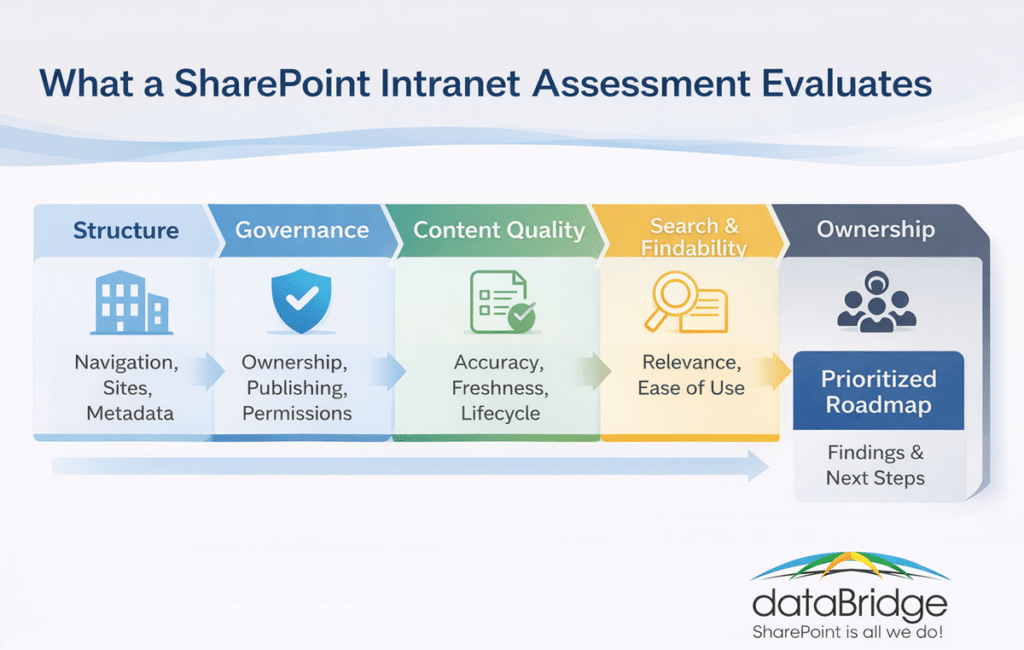
We assess the core elements that shape intranet performance, including site structure, navigation, content quality, governance maturity, ownership clarity, permissions patterns, and overall usability. Where relevant, we also look at how the intranet supports broader document management, communication, and knowledge access goals.
In many environments, the homepage is not the biggest issue. The deeper issue is that the homepage is trying to compensate for weak architecture underneath it. That is an important distinction, because it changes the solution.
When the assessment shows that weak architecture is limiting the intranet, SharePoint architecture and governance consulting gives your team a focused path to redesign the site model, hub structure, navigation, ownership, permissions, content lifecycle, and governance rules before rebuilding the experience.
Gap Identification
We identify the structural, governance, and content gaps that are preventing the intranet from working the way leadership and users expect. This may include inconsistent information architecture, overlapping content, weak publishing discipline, confusing site relationships, or missing governance controls.
When needed, this analysis also connects to adjacent topics like SharePoint information architecture and metadata, because findability problems are often rooted in taxonomy, structure, and content design rather than interface decisions alone.
Risk and Friction Review
Not every intranet problem looks dramatic, but many create steady drag on the business. Employees lose time. Leaders lose trust in the platform. Content owners avoid cleanup because responsibility is unclear. Department sites drift apart. Search quality weakens. These issues are expensive precisely because they become normal.
We review the friction points that are reducing value today and the risks that will continue to grow if the environment is left as-is.
Prioritized Recommendations
You receive recommendations that are practical, sequenced, and grounded in how organizations actually operate. We do not hand over a long wish list and leave you to interpret it. We show you what matters most, what can wait, and which changes will produce the strongest return first.
That often includes quick wins, structural corrections, governance improvements, and decision points around whether the next phase should be targeted optimization or broader intranet consulting.
Roadmap for Next Steps
The final outcome is clarity. You leave with a roadmap that helps your team move forward with confidence, whether that means internal remediation, phased improvements, or a broader engagement with dataBridge. For many organizations, this is the step that turns uncertainty into direction.
It also creates a better foundation for future priorities like search improvement, stronger governance, more consistent communication, and long-term readiness for tools that depend on well-structured content across Microsoft 365.
How This Assessment Differs From Other dataBridge Services
This page is intentionally focused.
This is not the same as our broader SharePoint Discovery & Readiness Assessment, which evaluates wider SharePoint and Microsoft 365 conditions across planning, structure, and platform direction.
It is not the same as our SharePoint Intranet Consulting Services page, which covers larger consulting, design, improvement, and transformation engagements.
This is not the same as our modern SharePoint intranet guide, which is designed to educate and frame the topic more broadly.
It is not the same as our SharePoint intranet adoption strategy, which focuses on launch, reinforcement, usage, and sustainment after the environment is in place.
This page sits between broad concern and broad commitment. It is the right fit for organizations that need an expert view of the problem before choosing the solution.
Why dataBridge
At dataBridge, we do not treat intranet issues as isolated design problems. We evaluate them in the context of structure, governance, content, search, and long-term Microsoft 365 health.
That matters because an intranet is not just a communications layer. It is part of the operational fabric of SharePoint. When it is structured well, users find information faster, content stays more trustworthy, and the platform supports better outcomes across collaboration, knowledge access, and governance.
We have seen for years that organizations get better results when they start with clarity instead of assumptions. That principle runs throughout our work, from intranet planning to governance strategy to the broader insights we publish in the SharePoint & Microsoft 365 Knowledge Center. It also aligns with the way we support organizations across different use cases and sectors through our Industry-Specific SharePoint Intranet Solutions.
Related SharePoint Intranet Assessment Resources
- SharePoint Intranet Consulting Services
- How to Design and Build a Modern SharePoint Intranet
- SharePoint Branding, UX & Page Template Design
- SharePoint Intranet Adoption Strategy
- SharePoint Information Architecture & Metadata Consulting
- SharePoint Hub Site & Enterprise Intranet Architecture Framework
- Why Employees Don’t Trust SharePoint
Frequently Asked Questions
How long does a SharePoint Intranet Assessment take?
Most assessments are completed within a few weeks, depending on the size, complexity, and condition of the current environment.
Do we need to prepare a lot before the assessment starts?
No. We guide the process and request the access, context, and stakeholder input needed to evaluate the intranet effectively.
Will dataBridge make changes during the assessment?
No. The assessment is focused on evaluation, findings, and recommendations. Any implementation work happens only if your organization chooses to move forward.
Can our internal team use the roadmap without hiring dataBridge for the next phase?
Yes. Some organizations use the roadmap internally, while others engage us for improvement, redesign, governance work, or ongoing consulting support.
Does this assessment cover governance and content quality, or just design?
It covers much more than design. Governance, ownership, content quality, navigation, structure, and usability are central to the assessment. In most intranet environments, those factors matter more than visual polish alone.
Start With Clarity
If your intranet is underperforming, guessing is expensive.
A better intranet does not start with a prettier homepage. It starts with a clear understanding of what is limiting trust, findability, ownership, and value today.
A SharePoint Intranet Assessment gives you that clarity. It helps your team move from broad frustration to a practical roadmap, with recommendations grounded in how SharePoint actually works inside real organizations.
If you know your intranet should be doing more, this is the right place to start.
Schedule a conversation with dataBridge to discuss your SharePoint Intranet Assessment.
What Our Clients Say