
SharePoint Information Architecture & Metadata Consulting
SharePoint information architecture and metadata services help organizations structure content so search, governance, navigation, automation, retention, and Copilot work more effectively across Microsoft 365. dataBridge focuses on building scalable frameworks that support clarity, findability, and long-term platform usability.
When information architecture is weak, everything around it becomes harder. Search becomes less reliable, governance becomes harder to enforce, and users lose confidence in the system. This page explains how dataBridge approaches metadata and information architecture so SharePoint environments are easier to navigate, manage, and scale.
Written by Michael Fuchs, Founder and CEO of dataBridge. Reviewed by Ken Lewis, Principal Consultant, for SharePoint information architecture, metadata strategy, document management, governance, records management, and Microsoft 365 compliance accuracy.
Published: January 25, 2026
Last reviewed: May 29, 2026
Design Structure That Makes SharePoint Work
dataBridge helps organizations design SharePoint information architecture and metadata models that improve findability, governance, permissions alignment, and long-term usability across Microsoft 365. This consulting engagement is built for teams that need practical structure, not just theory, so SharePoint can scale cleanly across departments and content types.
If you are looking for the broader educational framework, start with our complete SharePoint metadata strategy guide.
Where the guide explains the broader framework, this page explains how dataBridge helps organizations apply that framework in a real environment. Our work typically includes architecture design, metadata planning, governance alignment, migration support, and readiness for search, automation, and Copilot.
This page focuses on the consulting service: how dataBridge helps organizations plan, design, and implement SharePoint information architecture and metadata in a real Microsoft 365 environment. For the educational explanation of metadata concepts, content types, taxonomy, and implementation sequence, start with the SharePoint Metadata Strategy Guide. For the broader business document platform, use the SharePoint Document Management System page.
For migration projects, this work should be planned before content moves, which is why many teams also review the SharePoint migration planning checklist alongside architecture and metadata design.
These architecture capabilities are part of our broader SharePoint & Microsoft 365 consulting solutions, which bring together strategy, governance, migration planning, and collaboration design to help organizations build structured, scalable Microsoft 365 environments.
As organizations begin preparing for Microsoft Copilot, structural discipline becomes even more critical. Our detailed guide on Copilot-ready information architecture explains how metadata consistency, governance alignment, and search configuration directly impact AI reliability and output accuracy.
For the broader resource map behind those AI-readiness decisions, use the SharePoint architecture for AI readiness hub, which connects metadata, permissions, source authority, lifecycle governance, search, and SharePoint agents.
Why Information Architecture and Metadata Matter
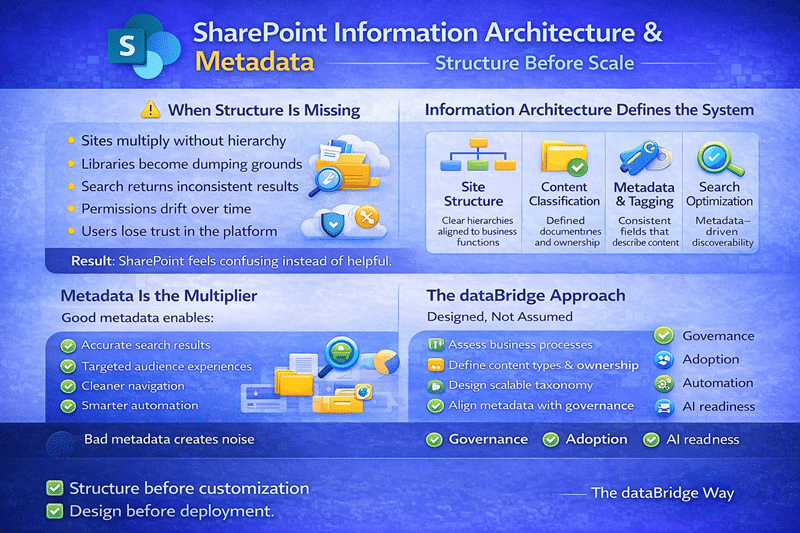
As SharePoint environments grow, structure becomes a practical business issue. Without clear information architecture and metadata, organizations usually see the same pattern: content sprawl, inconsistent naming, weak search trust, permissions complexity, and lower adoption.
This is where consulting matters. dataBridge helps organizations turn broad structural concerns into a working architecture model that supports governance, findability, and long-term Microsoft 365 usability.
Those same structural decisions sit at the center of an effective SharePoint Document Management System, where metadata, permissions, search, and lifecycle governance work together to keep business content secure, discoverable, and manageable at scale.
For a deeper breakdown of how metadata structures are designed and governed, see our complete guide to SharePoint metadata strategy. Together, they turn SharePoint from a file repository into a usable, governable platform.
At dataBridge, we design both with business outcomes in mind, not just technical convenience.
When metadata issues reflect a broader governance gap, the SharePoint Governance Maturity Scorecard helps teams score metadata maturity alongside ownership, permissions, lifecycle, records, search, Copilot readiness, adoption, and support.
What This Looks Like in Practice
A professional services firm may have thousands of documents organized by client, department, project, and year. At first, folders feel familiar. Over time, people create different naming patterns, duplicate templates, and inconsistent locations for the same type of work.
dataBridge helps translate that messy structure into a practical information architecture. The work may include site and hub design, content types, metadata fields, views, term sets, ownership rules, and search-supporting labels that match how the business actually works.
For some organizations, this becomes the foundation for a stronger SharePoint Document Management System. For others, it supports Copilot-ready SharePoint information architecture or migration planning before old folder structures are moved into a new environment. Metadata only works when people understand why it exists and when the structure is simple enough to maintain.
Before redesigning libraries, use the SharePoint document library maturity assessment to score whether structure, ownership, metadata, permissions, search, lifecycle controls, and Copilot readiness are strong enough to support the new architecture.
When the team needs a lighter planning step before consulting, the SharePoint information architecture planning worksheet helps document libraries, metadata, content types, ownership, search needs, and 30/60/90-day priorities before implementation.
Once those fields are defined, SharePoint metadata intake forms can help translate the architecture plan into a cleaner user experience for document submissions, policy uploads, contract intake, and other repeatable library processes.
How This Consulting Page Fits With Related Metadata Resources
This page explains how dataBridge helps organizations apply information architecture and metadata planning in real environments.
Use the related resources this way:
- Use the SharePoint Document Management System page when the main question is how SharePoint should support enterprise document management.
- Use the SharePoint Metadata Strategy Guide when you need the broader educational framework for metadata, content types, and classification.
- Use SharePoint Taxonomy and Metadata Strategy when the problem is inconsistent terminology, term sprawl, managed metadata, or enterprise term store design.
- Use the SharePoint Hub Site Architecture Framework when the main issue is hub grouping, navigation, site relationships, and intranet structure.
- Use Copilot-Ready SharePoint Information Architecture when the architecture needs to support AI retrieval, source authority, and Copilot grounding.
Our Approach to SharePoint Information Architecture
Start with How the Business Works
Before designing sites, libraries, or metadata, we focus on understanding how your organization actually operates.
We assess:
- How teams collaborate and share information
- What content is most critical to daily work
- Who owns information and decisions
- How content flows across departments
- What leaders need visibility into
This discovery work often begins as part of a
SharePoint Discovery & Readiness Assessment
and ensures architecture decisions align to real workflows—not assumptions.
Design a Scalable Site and Hub Structure
How Information Architecture Reduces Governance Burden
Next, we design a SharePoint architecture that supports growth without chaos. A scalable architecture also needs SharePoint site provisioning standards so new sites follow the right structure, hub association, naming model, ownership expectations, and lifecycle rules before content starts spreading across the environment.
This includes:
- Communication sites, team sites, and hubs
- Logical separation of collaboration vs. publishing
- Clear ownership and responsibility boundaries
- Consistent navigation patterns across hubs
We avoid over-engineering while still planning for scale. As a result, SharePoint remains intuitive for users and manageable for administrators.
For the design principles behind a structure that scales, see our guide to designing scalable SharePoint information architecture.
This work aligns closely with SharePoint architecture and governance consulting because sites, hubs, metadata, permissions, ownership, lifecycle, and policy decisions need to reinforce one another after launch.
Information architecture is one component of a broader digital workplace strategy. Organizations often address architecture alongside governance, migration planning, and intranet design as part of a structured SharePoint and Microsoft 365 consulting solutions approach.
Metadata That Supports Findability and Governance
Move Beyond Folders
Folders alone don’t scale. Metadata enables users to find, filter, and manage content across sites and libraries—without relying on deep folder structures.
This becomes especially important during migration, when organizations need to map legacy folder structures to metadata in SharePoint instead of carrying old path-based logic into a new environment.
When those legacy folders come from network drives or file servers, file share migration to SharePoint should include destination architecture, folder-to-metadata mapping, permission cleanup, and governance decisions before content is moved.
We design metadata strategies that:
- Reflect business language and processes
- Reduce duplication and ambiguity
- Support filtering, views, and search
- Enable reporting and lifecycle management
Metadata becomes a tool users rely on, not avoid.
| Metadata Field | Purpose |
|---|---|
| Department | Filters content by team |
| Document Type | Distinguishes contracts vs policies |
| Sensitivity | Drives security and retention |
Lifecycle | Triggers cleanup and archiving |
As environments grow, ad hoc metadata quickly leads to duplication and term sprawl. A structured SharePoint taxonomy and metadata strategy ensures consistent classification across hubs, libraries, and business units—supporting long-term search accuracy and governance enforcement.
While strong information architecture benefits every organization, regulated industries require additional structural safeguards. Our SharePoint architecture for regulated industries framework outlines how metadata, retention, and security controls must be intentionally aligned to support audit and compliance requirements.
Organizations researching information architecture, taxonomy strategy, and governance alignment in more depth can explore our SharePoint & Microsoft 365 Knowledge Center, which contains detailed guidance on metadata strategy, migration planning, and long-term Microsoft 365 architecture.
Define Metadata at the Right Level
Effective metadata starts with consistency. We help organizations define metadata at the appropriate level, including:
- Tenant-level content types
- Reusable site columns
- Library-specific metadata where appropriate
- Required vs. optional fields
This approach ensures metadata remains consistent while still flexible enough to support different teams.
Site-level design decisions directly influence scalability and navigation clarity. Our detailed SharePoint hub site architecture framework explains how hub grouping logic, navigation standards, and governance alignment determine long-term intranet performance.
Design for Security, Retention, and Compliance
Metadata plays a critical role in governance. We design it to support:
- Sensitivity labels
- Retention policies
- Permissions models
- Records management
By embedding metadata into governance strategies, organizations reduce risk while maintaining usability.
That work becomes much easier when control definitions are clear. Our article on retention labels vs sensitivity labels vs permissions in SharePoint helps explain how metadata strategy supports each control without blending security, lifecycle, and access into one vague governance bucket.
This often complements
SharePoint Migration Consulting
where content cleanup and reclassification are essential.
Information Architecture That Enables Search and AI
Why Metadata Improves SharePoint Search
Search and AI only work when the structure behind them is reliable. If users see inconsistent results, the problem may not be search alone. It may be the combination of permissions, metadata, source quality, and ownership behind the content. That is why inconsistent SharePoint search results are often a sign of a larger information architecture issue.
Well-designed information architecture and metadata:
- Improve Microsoft Search accuracy
- Enable meaningful filters and refiners
- Support Copilot summaries and comparisons
- Reduce hallucinations and misinformation
As organizations prepare for Copilot, structure becomes even more critical. Poor metadata leads to poor AI outcomes.
Metadata and taxonomy are the machinery that makes content retrievable, but retrieval is the means, not the end. For how they fit the larger goal of turning a document store into a knowledge system people can get answers from, see our guide to knowledge management in SharePoint.
While metadata enables flexible organization, many organizations still rely heavily on folder hierarchies. Understanding the difference is essential for modern SharePoint design. Our guide on folders vs metadata in SharePoint and why it matters for AI explains how these approaches impact search, governance, and Microsoft Copilot.
That’s why this work is foundational to Copilot readiness and Microsoft 365 optimization initiatives. As AI adoption increases, taxonomy discipline becomes even more consequential. Structured term stores and consistent metadata application directly influence Copilot retrieval behavior. Learn more in our guide to Copilot-Ready SharePoint Information Architecture.
Integrating Architecture With Adoption and Governance
Information architecture should not live in a diagram. It should shape how users navigate, classify, search, publish, and maintain content.
dataBridge connects architecture decisions to:
- Site ownership
- Library structure
- Metadata standards
- Permissions alignment
- Governance expectations
- Search and navigation behavior
- User training and adoption
When users understand why SharePoint is organized the way it is, adoption improves naturally. The structure becomes easier to follow because it reflects how people actually work.
Common Architecture and Metadata Problems We Fix
Organizations often come to dataBridge after experiencing:
- Overuse of folders and document libraries
- Inconsistent metadata across sites
- Poor search results and low user trust
- Excessive unique permissions
- Difficulty migrating or modernizing content
We help untangle these environments and redesign structure without disrupting day-to-day work.
Who This Is Best For
Our information architecture and metadata services are ideal for organizations that:
- Rely heavily on SharePoint and Microsoft 365
- Need structure to support scale and governance
- Are preparing for migration or Copilot
- Want better search, reporting, and visibility
- Value long-term platform health over quick fixes
If you’re exploring related topics like governance, migration planning, or Microsoft Teams architecture, our practical guides and resources provides a collection of practical guides and resources.
Many organizations also explore our industry-specific SharePoint intranet solutions to understand how information architecture, governance requirements, and compliance considerations vary across healthcare, financial services, government, education, and other regulated sectors.
Good Information Architecture vs. Poor Information Architecture
A Clear Contrast
Good Information Architecture
- Clear site hierarchy aligned to business functions
- Defined content types and ownership
- Consistent, governed metadata fields
- Search results that are predictable and relevant
- Permissions aligned to business intent
- Scalable structure that supports automation and AI
Outcome:
Users trust the platform. Search works. Governance feels natural. The environment scales.
Poor Information Architecture
- Sites created without structural alignment
- Libraries used as dumping grounds
- Inconsistent or missing metadata
- Search results that feel random
- Permission sprawl and ownership confusion
- Reactive governance and cleanup cycles
Outcome:
Users lose trust. Search becomes unreliable. Governance becomes a policing exercise.
The dataBridge Difference
Many firms treat information architecture as documentation.
dataBridge treats it as strategy.
We combine:
- Deep SharePoint expertise
- Real-world governance experience
- Business-first consulting
- Practical implementation guidance
As a result, the structure we design doesn’t just look good—it works.
Get Started with SharePoint Information Architecture
If your SharePoint environment feels cluttered, difficult to manage, or unprepared for what’s next, information architecture is the place to start.
Begin with a SharePoint Discovery Engagement and let dataBridge help you design structure that brings clarity, control, and confidence to SharePoint.
Frequently Asked Questions
1️⃣ Why is information architecture more important than site design in SharePoint?
Information architecture determines how content is structured, classified, secured, and discovered — long before visual design comes into play. While site design affects user experience, architecture governs how information behaves across the entire Microsoft 365 environment. Poor architecture leads to inconsistent metadata, unreliable search, permission sprawl, and governance challenges. Strong architecture ensures that design, automation, collaboration, and AI capabilities all operate on a stable foundation.
2️⃣ How does metadata improve SharePoint search and Copilot accuracy?
Metadata gives context to content. When documents are consistently tagged with structured fields — such as department, document type, sensitivity level, or lifecycle stage — SharePoint search can return predictable, relevant results instead of keyword-based guesses. In modern Microsoft 365 environments, metadata also improves Copilot grounding. AI systems rely on structured, governed content to generate trustworthy responses. Without metadata discipline, AI amplifies confusion instead of clarity.
3️⃣ What is the biggest mistake organizations make with SharePoint information architecture?
The most common mistake is designing structure after content has already scaled. Organizations often migrate files first and attempt to impose architecture later. By that point, inconsistent naming, duplicated content, and fragmented permissions are already embedded in the environment. Effective SharePoint architecture must be intentional from the beginning — aligned to business functions, ownership models, governance requirements, and long-term scalability.