
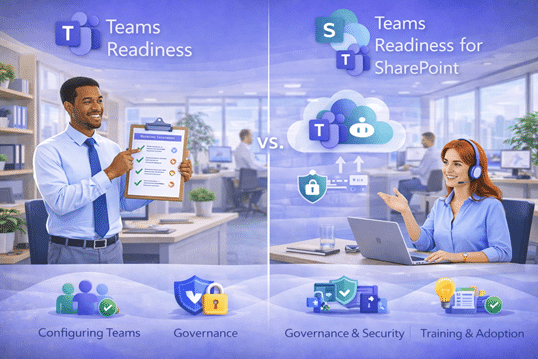
Microsoft Teams Readiness vs. Teams Readiness for SharePoint
Microsoft Teams works best when it’s designed with intention. dataBridge helps organizations bring structure, governance, and clarity to Microsoft Teams—reducing sprawl, improving adoption, and ensuring Teams integrates cleanly with SharePoint and Copilot.
Understanding the Difference—and Why It Matters
Microsoft Teams doesn’t operate in isolation.
Every Team relies on SharePoint for files, permissions, structure, and long-term content management. Because of that, organizations often struggle when they assess Teams without evaluating the SharePoint foundation behind it.
At dataBridge, we distinguish between two related—but very different—assessments:
- Microsoft Teams Readiness Assessment
- Microsoft Teams Readiness Assessment for SharePoint
Understanding the difference helps organizations fix root problems instead of treating symptoms.
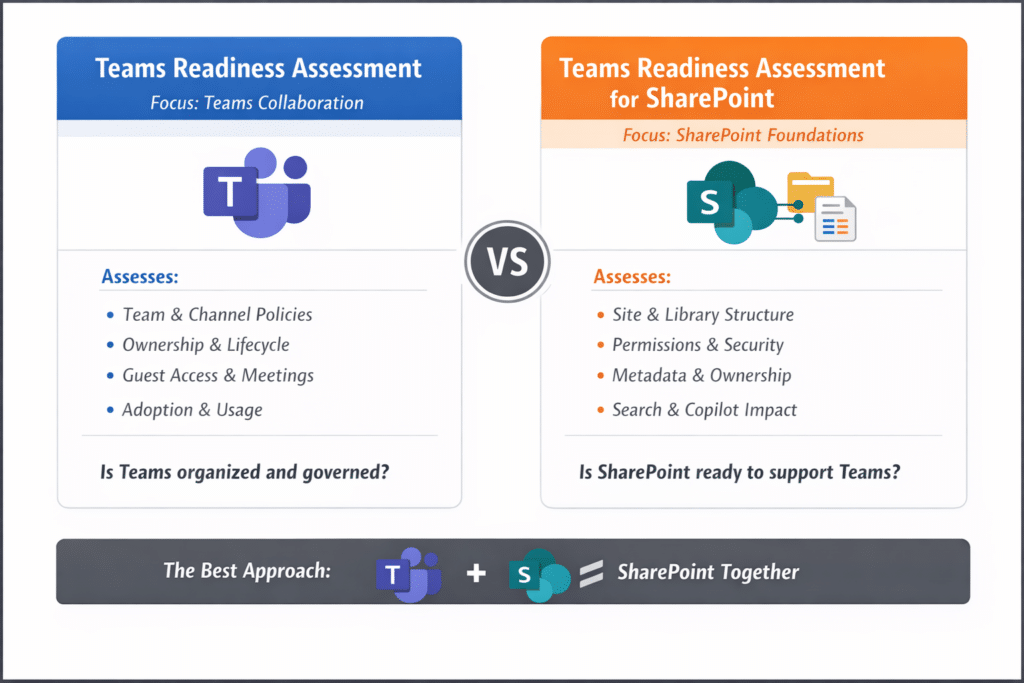
Microsoft Teams Readiness Assessment
Focus: How Teams Is Used and Governed
A Microsoft Teams Readiness Assessment evaluates how well your organization uses, governs, and scales Teams as a collaboration tool.
This assessment looks directly at Teams behavior, structure, and policies.
What this assessment evaluates
- Team and channel structure
- Team creation policies and sprawl
- Ownership and lifecycle management
- Standard, private, and shared channel usage
- Guest access and external collaboration
- Meetings, chat, and collaboration patterns
- Adoption trends and usage consistency
- Teams governance settings and controls
The core question it answers
Is Microsoft Teams organized, governed, and usable at scale?
Organizations typically request this assessment when:
- Teams feels noisy or overwhelming
- Collaboration lacks consistency
- Ownership and accountability feel unclear
- Adoption varies widely across departments
This assessment helps Teams work better as a collaboration experience.
Microsoft Teams Readiness Assessment for SharePoint
Focus: The Foundation That Teams Depends On
A Microsoft Teams Readiness Assessment for SharePoint evaluates whether SharePoint is properly designed to support Teams.
Every Team includes:
- A SharePoint site
- One or more document libraries
- SharePoint-based permissions
- SharePoint search and metadata
If SharePoint isn’t ready, Teams will struggle—no matter how well Teams itself is configured.
What this assessment evaluates
- SharePoint site architecture behind Teams
- Document library and folder structure
- Metadata and content organization
- Permissions and inheritance models
- Role-based access vs. individual access
- Content ownership and lifecycle management
- Search behavior for Teams files
- Governance alignment between Teams and SharePoint
- Copilot readiness related to Teams content
The core question it answers
Is SharePoint ready to support Teams—and the way people actually work in it?
Organizations often request this assessment when:
- Files feel hard to find in Teams
- Permissions feel risky or unpredictable
- Copilot surfaces the wrong content
- Teams and SharePoint feel misaligned
This assessment fixes the root causes behind many Teams problems.
The Key Difference, Simply Explained
| Assessment | Primary Focus | Solves |
|---|---|---|
| Teams Readiness Assessment | Teams usage, structure, and governance | Collaboration chaos, sprawl, adoption issues |
| Teams Readiness for SharePoint | SharePoint foundations behind Teams | File confusion, permission risk, Copilot accuracy |
A Teams-only assessment improves how people collaborate.
A Teams-for-SharePoint assessment improves how collaboration actually works.
Why This Distinction Matters More Now
With Microsoft Copilot relying on both Teams conversations and SharePoint content, the stakes are higher than ever.
When SharePoint is poorly structured:
- Teams files feel scattered
- Search becomes unreliable
- Copilot surfaces noise instead of insight
- Trust in AI declines
Teams readiness without SharePoint readiness often treats symptoms.
Assessing both creates sustainable improvement.
How dataBridge Approaches Teams Readiness
At dataBridge, we take a foundation-first approach:
- Evaluate Teams usage and governance
- Evaluate SharePoint structure, security, and ownership
- Align both to Copilot readiness and long-term adoption
This approach delivers:
- Cleaner Teams environments
- Predictable permissions
- Trusted search
- Better AI outcomes
- Scalable governance
The Bottom Line
- A Microsoft Teams Readiness Assessment improves collaboration behavior.
- A Microsoft Teams Readiness Assessment for SharePoint strengthens the foundation that makes collaboration work.
- Organizations that address both get the best results—especially with Copilot.
If Teams feels chaotic or AI results feel unreliable, the issue usually isn’t Teams alone. It’s the SharePoint foundation underneath it.
Ready to Assess Your Teams Environment?
If you’re unsure whether your Teams environment—or the SharePoint behind it—is ready to scale, we can help.