
SharePoint Governance Maturity Model
The SharePoint Governance Maturity Model helps organizations assess how well governance is defined, applied, and sustained across Microsoft 365. It gives teams a practical way to understand current-state weaknesses, prioritize improvement, and move from reactive platform management toward a more intentional operating model.
Governance maturity is not only about having policies. It is about whether ownership, lifecycle control, permissions, content standards, and review processes are actually functioning in day-to-day work. This page explains how dataBridge uses a maturity model to help organizations understand where they are and what should improve next.
This page focuses on assessment, maturity stages, benchmarking, and improvement planning. For the full governance foundation, use our SharePoint Governance Guide. For the operating model used to implement governance, use our SharePoint Governance Framework.
How Governance Evolves — and Why Most Organizations Stall Too Early
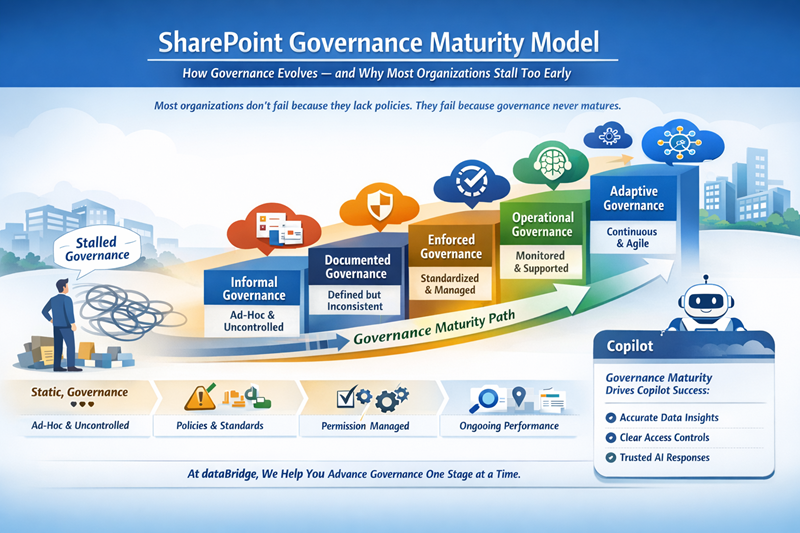
Most organizations don’t fail at SharePoint governance because they lack policies.
They fail because governance never matures.
Early governance efforts often start with good intentions — defining rules, assigning owners, and documenting standards. However, without a clear maturity path, governance stalls. It becomes static while the platform, the business, and tools like Copilot continue to evolve.
If you need the broader foundation before evaluating maturity stages, start with our complete SharePoint governance guide.
At dataBridge, we use a governance maturity model to help organizations understand where they are today, what risks exist at each stage, and how to move forward without over-engineering or bureaucracy.
This guide breaks down what governance maturity actually looks like — and how to progress deliberately.
Quick Answer: What Is a SharePoint Governance Maturity Model?
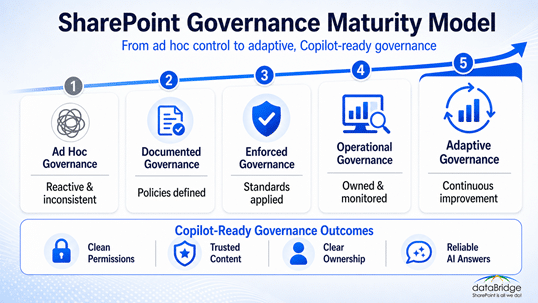
A SharePoint governance maturity model helps organizations evaluate how consistently governance is working across ownership, permissions, site provisioning, lifecycle management, metadata, compliance, and ongoing review. It shows whether governance is informal, documented, enforced, operational, or adaptive.
Written by Michael Fuchs, Founder and CEO of dataBridge. Reviewed by Ken Lewis, Principal Consultant, for SharePoint governance, records management, compliance-driven information architecture, lifecycle, and Microsoft 365 governance accuracy.
Published: February 10, 2026
Last reviewed: May 29, 2026
What Is a SharePoint Governance Maturity Model?
A SharePoint governance maturity model describes how governance evolves from informal, reactive decisions into a structured operating model that scales with the organization.
Rather than treating governance as a one-time project, the model recognizes governance as a living system — reinforced through structure, process, and behavior.
A mature governance model aligns:
- Decision ownership
- Policies and standards
- Day-to-day operating rhythms
- Ongoing feedback from real usage
Without maturity, governance exists on paper. With maturity, governance shapes behavior by default.
Once your team understands the maturity stages, use the SharePoint Governance Maturity Scorecard and related planning tools to score the current state and connect governance findings to Copilot readiness, migration planning, permission review, and intranet improvement.
This maturity model helps organizations identify where governance is breaking down and what should improve next. For the broader governance foundation, including policies, ownership models, lifecycle controls, and implementation guidance, start with our SharePoint Governance Guide.
The Five Stages of SharePoint Governance Maturity
Informal Governance
At this stage, governance is mostly implied.
Decisions are made by whoever speaks up first. Standards may exist, but they aren’t enforced. Ownership is unclear, and exceptions are common.
Typical signs include:
- Inconsistent site structures
- Ad-hoc permissions
- Users creating workarounds outside SharePoint
This stage often feels “flexible,” but it introduces long-term risk — especially around governance and compliance controls
Documented Governance
Organizations at this stage begin formalizing governance.
Policies are written. Roles are defined. Standards are published. However, enforcement still relies on awareness rather than structure.
While this is progress, governance often struggles because teams don’t fully understand governance roles vs responsibilities.
Governance exists — but adoption is inconsistent.
Enforced Governance
At this stage, governance moves from documentation to design.
Standards are enforced through:
- Site provisioning processes
- Permission models
- Information architecture decisions
Governance is no longer optional because the platform supports it by default. This is where SharePoint governance frameworks begin to hold up under scale.
At this stage, governance becomes visible in the structure of the environment. Site requests follow defined paths, permissions follow approved models, and information architecture decisions support consistency instead of relying on individual team preference.
A governed SharePoint site provisioning strategy is often one of the clearest signs that an organization has moved beyond documented governance. Site requests, templates, approvals, ownership, permissions, and lifecycle expectations are built into the operating model instead of handled as exceptions.
Organizations at this stage usually see reduced sprawl and stronger consistency, but governance may still be more reactive than adaptive.
Operational Governance
Operational governance introduces rhythm.
Governance is reviewed regularly, reinforced through support, and connected to real platform activity like migrations and new workloads.
This stage is where governance readiness for Copilot becomes possible, because structure, ownership, and permissions are predictable.
Governance decisions are no longer one-off events — they are part of how the organization operates SharePoint day to day.
Adaptive Governance
Adaptive governance is the highest maturity level — and the rarest.
Here, governance evolves continuously based on:
- Usage patterns
- Organizational change
- Platform updates
- AI adoption
Feedback loops connect governance reviews, platform usage, content health, permission changes, site lifecycle decisions, and new Microsoft 365 capabilities into one continuous improvement process.
Governance does not slow the organization down. Mature governance helps SharePoint change with the business while keeping ownership, structure, permissions, and lifecycle expectations clear.
Once organizations identify their current maturity stage, the next step is choosing the right improvement path. For the full governance model behind those improvements, use our SharePoint Governance Guide. For the operating structure behind roles, decision rights, and review cadence, use our SharePoint Governance Framework.
SharePoint Governance Maturity Scorecard
Use this scorecard to identify where governance needs improvement.
For the full worksheet version, use the SharePoint Governance Maturity Scorecard to score your current state across ownership, permissions, lifecycle, metadata, records, search, Copilot readiness, adoption, and support model maturity.
Governance area | Low maturity signal | Higher maturity signal |
Site ownership | Owners are missing, inactive, or informal | Every site has a primary and backup owner |
Site provisioning | Sites are created manually or inconsistently | Requests follow approved templates and review paths |
Permissions | Access is granted through one-off exceptions | Permissions follow role-based models and review cycles |
Content lifecycle | Old sites and files remain active indefinitely | Sites and content have review, archive, and retirement paths |
Metadata and structure | Libraries vary by team preference | Metadata and structure follow defined patterns |
External sharing | Sharing is handled case by case | Guest access and sharing links follow defined rules |
Governance review | Governance is reviewed only after problems | Governance is reviewed on a recurring cadence |
Why Governance Maturity Matters More Than Governance Volume
Adding more rules does not improve governance maturity.
In fact, overly complex governance models often collapse under their own weight. Mature governance is not about control — it’s about clarity.
Successful organizations focus less on policy volume and more on:
- Decision clarity
- Structural enforcement
- Ongoing reinforcement
- Measurable improvement over time
This is why governance maturity affects adoption, security, search, compliance, and AI readiness. Metadata quality is one important signal of maturity, but it should be evaluated as part of the broader governance model. For the deeper metadata strategy, use our SharePoint Taxonomy and Metadata Strategy.
How Governance Maturity Affects Copilot Outcomes
Copilot does not create new information — it surfaces what already exists.
If governance maturity is low:
- Copilot retrieves inconsistent or outdated content
- Permissions are unclear, increasing risk
- Users lose trust in AI responses
As governance maturity increases, Copilot benefits from:
- Consistent structure and metadata
- Clear ownership and lifecycle management
- Predictable access controls
This is why Copilot readiness for SharePoint is not only a licensing decision. It is also a governance maturity decision.
Moving Forward Without Over-Engineering Governance
One of the biggest governance mistakes organizations make is jumping straight to “best practices” without understanding their current maturity.
Progressing through governance maturity should be:
- Intentional
- Incremental
- Aligned to business priorities
At dataBridge, we focus on advancing governance one stage at a time — reinforcing what exists before introducing complexity.
The goal is not perfect governance.
The goal is governance that works.
The dataBridge Perspective
After years of SharePoint consulting one pattern is consistent:
Organizations with mature governance don’t spend less time on SharePoint — they spend less time fixing SharePoint.
Moving up the governance maturity curve requires more than policy awareness. It requires clear ownership, consistent implementation, recurring review, and a practical way to measure whether governance is improving.
A strong governance maturity model gives leaders a clearer view of current-state risk and next-step priorities. It helps SharePoint evolve with the business while reducing the chance that growth, new workloads, or Copilot adoption will expose unresolved governance gaps.
For a broader path through related dataBridge governance resources, use the SharePoint governance resources hub to connect maturity assessment with the Governance Guide, Governance Framework, site provisioning, permissions, page governance, search governance, records, and Copilot readiness.
For the broader governance foundation, use our SharePoint Governance Guide. For additional SharePoint and Microsoft 365 planning resources, visit the SharePoint & Microsoft 365 Knowledge Center.
If your organization is not sure whether governance is informal, documented, enforced, operational, or adaptive, dataBridge can help assess your current state and identify the next practical improvements. Contact us today to start the conversation.