Skip to content
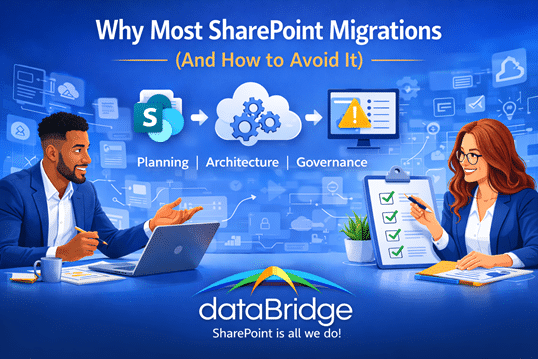
SharePoint migration consulting illustration showing planning, architecture, and governance to avoid common SharePoint migration mistakes

Why Most SharePoint Migrations Fail (And How to Avoid It)

Moving Content Is Easy. Getting It Right Is the Hard Part.

Migrating to SharePoint is more than a technical task. While migration tools can move files quickly, successful SharePoint migrations depend on strong information architecture, governance, security, and long-term usability—not just speed.

What Our Clients Say

dataBridge Client Logos

Why Most SharePoint Migrations Fail

  • Migration is treated as a file move.
  • They migrate broken governance into the cloud.
  • Underestimate the complexity of permissions.
  • Most ignore post-migration structure.

In our experience, the organizations that succeed treat migration as a strategic reset — not a technical upgrade.

We’ve guided migrations ranging from 50,000 documents to multi-terabyte environments.

Our senior SharePoint migration consultants have led 460+ enterprise migrations.

Why Most SharePoint Migrations Fail (And How to Avoid It)

Organizations migrate to SharePoint expecting a fresh start.

They want better collaboration, easier document management, improved search, and stronger governance. Microsoft positions SharePoint Online as the backbone of modern digital workplaces, and when implemented well, it truly can be.

Yet despite these expectations, many migrations struggle to deliver lasting value.

Search still fails to return useful results. Duplicate files multiply across teams. Permissions become confusing. And users begin storing information in Teams chats, personal folders, or email attachments because they no longer trust the system.

These outcomes are rarely caused by SharePoint itself. Instead, they usually stem from avoidable planning and architecture mistakes made before migration even begins.

Many organizations discover that avoiding these pitfalls requires guidance from an experienced SharePoint migration consultant who understands both technical migration tools and long-term information architecture planning.

After working with organizations across industries, a clear pattern emerges: most unsuccessful migrations follow the same predictable errors.

Understanding these SharePoint migration mistakes is the first step toward avoiding them.

Organizations that take a strategic approach—focused on architecture, governance, and adoption—typically see far stronger long-term outcomes. This is why many organizations begin with a SharePoint Discovery & Readiness Assessment before moving forward with migration planning.

You can explore additional planning guides and implementation insights in the SharePoint & Microsoft 365 Knowledge Center, which includes frameworks and articles designed to help organizations build scalable Microsoft 365 environments.


Why SharePoint Migrations Fail

At a technical level, SharePoint migrations are relatively straightforward. Modern migration tools can move content from file shares, legacy SharePoint environments, and other repositories into Microsoft 365 quickly.

However, the technical migration is rarely the hardest part.

The real challenge is ensuring the information architecture, governance model, and user experience support long-term success.

Many migrations fail because organizations treat them as IT infrastructure projects rather than organizational information management initiatives.

Instead of redesigning how information should be structured and governed, they simply move existing content into a new platform.

This approach may appear efficient. However, it often reproduces the same problems that existed before migration.

Common issues that migrate along with the content include:

  • Disorganized folder structures
  • Inconsistent naming conventions
  • Outdated files
  • Duplicate documents
  • Broken permissions

When these problems move into SharePoint unchanged, users quickly lose confidence in the system.

In many environments, the migration simply creates a new interface for the same old problems.

This is why experienced consultants emphasize architecture and governance before migration begins. Strategic planning through SharePoint Migration Consulting helps organizations design environments that remain usable and scalable long after the migration is complete.

Organizations in sectors such as healthcare, financial services, government, and manufacturing often face additional regulatory and collaboration challenges. These scenarios are explored in more detail within the SharePoint Intranet by Industry section.


The Hidden Cost of Lift-and-Shift Migrations

One of the most common migration strategies is known as lift-and-shift.

In a lift-and-shift migration, organizations move content from an existing system into SharePoint without redesigning its structure.

At first glance, this seems appealing.

It is faster. It reduces planning time. And it appears to minimize disruption.

However, lift-and-shift migrations often introduce hidden costs that appear months later.

Poor Search Results

SharePoint search depends heavily on structured content and metadata.

When files migrate with inconsistent folder structures and naming conventions, search results become unreliable. Users must navigate complex folder hierarchies instead of relying on search.

Over time, frustration grows.

Duplicate Content

Lift-and-shift migrations frequently transfer large volumes of duplicate content.

For example:

  • Multiple versions of the same document
  • Outdated project files
  • Obsolete department folders

These duplicates create confusion and increase storage costs.

More importantly, they reduce trust in the platform.

Broken Permissions

Legacy file shares often contain complex permission structures.

When these permissions migrate directly into SharePoint, they can become difficult to manage and audit.

Users may gain access to information they should not see—or lose access to files they need.

Copilot Confusion

As organizations adopt Microsoft Copilot, poorly structured content becomes an even greater challenge.

Copilot relies on accessible, well-organized information to generate accurate responses.

In environments with inconsistent governance and metadata, AI tools often produce unreliable results.

This is why many Copilot readiness initiatives begin with improving SharePoint information architecture.


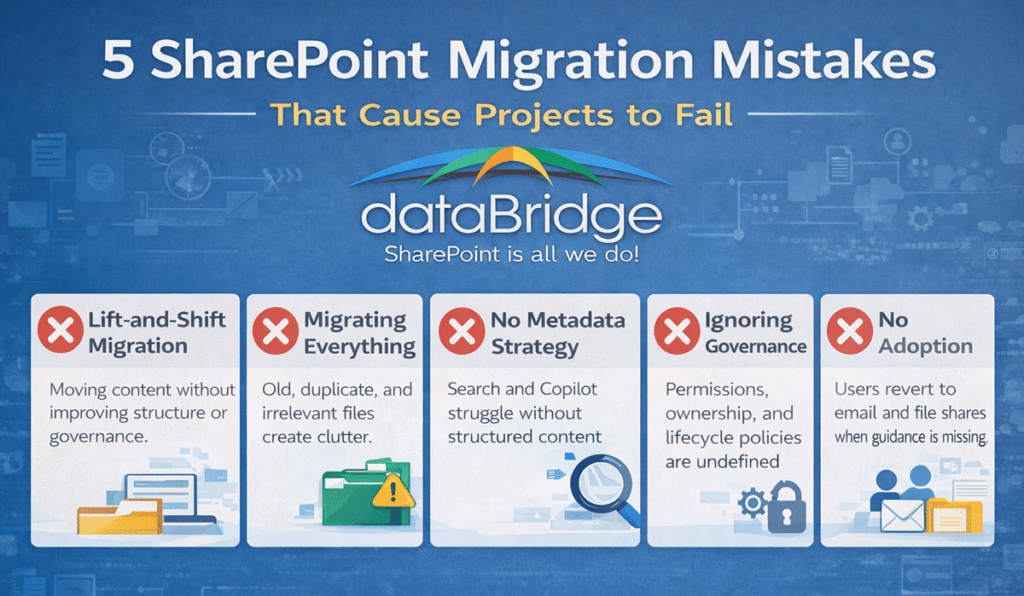
5 Common SharePoint Migration Mistakes

SharePoint migration mistakes infographic showing lift and shift migration risks, lack of governance, poor metadata strategy, duplicate content migration, and missing user adoption planning
Common SharePoint migration mistakes include lift-and-shift migrations, missing metadata strategies, and lack of governance. Addressing these issues early leads to far more successful SharePoint migrations.

While every organization faces unique challenges, most migration failures can be traced to a small set of recurring mistakes.

Understanding these pitfalls can dramatically improve migration outcomes.


1. Migrating Everything

Many organizations assume they should migrate every file from legacy systems.

However, legacy repositories frequently contain:

  • Outdated content
  • Duplicate files
  • Obsolete projects
  • Personal folders

Migrating everything increases storage costs and makes information harder to find.

In many environments, 30–50% of legacy content is no longer relevant.

A thoughtful migration strategy evaluates which content should move forward and which should be archived or retired.


2. Ignoring Information Architecture

Information architecture determines how content is organized, categorized, and discovered.

Without a clear architecture, SharePoint becomes little more than a file repository.

Effective architectures typically include:

  • Structured site collections
  • Consistent content types
  • Metadata classification
  • Intuitive navigation

Organizations that design architecture before migration almost always see stronger adoption and better search outcomes.


3. Over-Reliance on Folders

Legacy file shares rely heavily on nested folder structures.

While SharePoint supports folders, modern environments benefit from metadata-driven organization.

Metadata allows content to appear in multiple views without duplicating files.

For example, a document tagged with metadata could appear in views for:

  • Department
  • Project
  • Document type

This approach improves search accuracy and reduces reliance on deep folder hierarchies.


4. Ignoring Governance

Governance defines how content is created, managed, secured, and retained.

Without governance, SharePoint environments gradually become disorganized.

Common governance challenges include:

  • Inconsistent naming conventions
  • Uncontrolled site creation
  • Unclear ownership of content
  • Unmanaged permissions

Organizations that establish governance policies early avoid many of these problems.

The SharePoint Governance Guide provides a practical framework for defining policies that keep SharePoint environments organized and secure over time.

Additional governance strategies and technical planning insights can also be found in the SharePoint Resources section.


5. Skipping User Adoption Planning

Technology alone does not guarantee success.

Users must understand:

  • Where to store information
  • How to find document
  • Permissions and how they work
  • How collaboration tools integrate

Without training and clear guidance, users often revert to old habits.

Adoption planning ensures the migration leads to lasting behavioral change rather than temporary improvements.


How Governance Prevents Migration Chaos

Governance is one of the most overlooked aspects of SharePoint migrations, yet it is also one of the most important.

Governance establishes the rules that keep a SharePoint environment organized over time.

These rules typically address several key areas.

Site Creation

Who can create new sites?

Uncontrolled site creation often leads to sprawl and confusion. Governance ensures new sites follow consistent naming conventions and structural guidelines.

Permissions Management

Clear permission strategies reduce security risks and simplify administration.

Many organizations adopt group-based permissions rather than assigning access individually.

Content Lifecycle

Documents do not last forever.

Retention policies help organizations archive or delete outdated content automatically.

Ownership and Accountability

Every site should have a clear owner responsible for maintaining its content.

Without ownership, sites gradually become outdated and difficult to navigate.

Governance may seem restrictive at first, but in practice it protects the usability and reliability of the platform.


The dataBridge Migration Approach

Successful migrations combine technical expertise with strategic planning.

At dataBridge, migrations follow a structured methodology designed to ensure long-term success.

Rather than focusing only on moving files, the process emphasizes architecture, governance, and adoption.


1. Discovery and Assessment

Every engagement begins with understanding the current environment.

This includes evaluating:

  • Existing repositories
  • Content volume
  • Permission structures
  • Collaboration patterns
  • Governance maturity

Many organizations begin this process with a SharePoint Discovery & Readiness Assessment to identify risks and opportunities before migration begins.


2. Information Architecture Design

Next, the SharePoint environment is designed to support long-term usability.

Architecture planning includes:

  • Site hierarchy
  • Metadata strategy
  • Content types
  • Navigation structure
  • Security model

A well-designed architecture ensures users can easily find and manage information.


3. Migration Strategy and Phasing

Instead of migrating everything at once, many organizations benefit from phased migrations.

Phased approaches allow teams to:

  • Test new structures
  • Refine governance policies
  • Gather user feedback

This reduces disruption and improves adoption.


4. Governance Implementation

Governance policies are implemented alongside the migration.

These policies address:

  • Site provisioning
  • Permission management
  • Retention policies
  • Lifecycle management

Establishing governance early prevents environments from becoming disorganized over time.


5. Adoption and Enablement

Finally, users receive guidance and training on how to work within the new environment.

Adoption programs often include:

  • Quick-start guides
  • Role-based training
  • Department content owner playbooks
  • Governance documentation

Organizations planning new SharePoint environments often explore the broader service offerings available within the SharePoint Consulting Solutions section to better understand migration, architecture, and governance services.


What Does a SharePoint Migration Consultant Do?

A SharePoint migration consultant helps organizations plan and execute migrations that improve long-term usability rather than simply moving files.

Typical responsibilities include:

  • Assessing legacy content repositories
  • Designing SharePoint information architecture
  • Defining governance policies
  • Planning migration phases
  • Supporting user adoption and training

Working with an experienced SharePoint migration consultant helps organizations avoid common migration mistakes and build a SharePoint environment that supports collaboration, search, compliance, and future AI capabilities.


Final Thoughts on SharePoint Migration Success

Many organizations believe a SharePoint migration is primarily a technology project.

In reality, it is a structural transformation of how information is organized and shared.

Organizations that focus only on tools often repeat the same problems in a new environment.

Those that prioritize architecture, governance, and adoption create systems that scale for years.

Avoiding common SharePoint migration mistakes dramatically improves outcomes and ensures SharePoint becomes what it was intended to be: a reliable foundation for collaboration, knowledge sharing, and intelligent workplace tools.

Organizations preparing for migration often benefit from strategic guidance through SharePoint Migration Consulting, ensuring every step—from discovery through adoption—supports long-term success.

Frequently Asked Questions About SharePoint Migrations

Why do so many SharePoint migrations fail?

Most SharePoint migrations fail because organizations focus on moving files instead of improving structure. Without clear information architecture, governance policies, and metadata strategies, the same problems from legacy systems simply reappear in SharePoint.

Successful migrations focus on architecture, governance, and user adoption—not just technical migration.

What is the biggest mistake organizations make during a SharePoint migration?

The most common mistake is performing a lift-and-shift migration. While this approach moves content quickly, it often transfers outdated files, duplicate documents, and broken permission structures into the new environment.

A strategic migration evaluates which content should be migrated and redesigns the structure before moving data.

How long does a typical SharePoint migration take?

Migration timelines vary depending on the amount of content and the complexity of the environment. Smaller migrations may take a few weeks, while large enterprise migrations often occur in phases over several months.

Many organizations start with a SharePoint Discovery & Readiness Assessment to understand the scope and plan a realistic migration strategy.

Do you need a SharePoint migration consultant?

Organizations with large or complex environments often benefit from working with a SharePoint migration consultant. Consultants help design information architecture, establish governance policies, and plan migration phases to reduce risk.

Working with experienced advisors through SharePoint Migration Consulting can prevent costly mistakes and improve long-term usability.

Should you migrate everything to SharePoint?

In most cases, no. Legacy systems often contain large amounts of outdated or duplicate content. Migrating everything increases storage costs and makes information harder to find.

A well-planned migration identifies which content should be migrated, archived, or retired.

When should you hire a SharePoint migration consultant?

Organizations should consider hiring a SharePoint migration consultant when their migration involves large volumes of content, complex permission structures, or multiple legacy systems. A consultant helps evaluate the existing environment, design information architecture, establish governance policies, and plan a phased migration strategy.

Working with an experienced consultant through SharePoint Migration Consulting helps organizations avoid common migration mistakes and ensures the new SharePoint environment is structured for long-term usability rather than simply moving files from one system to another.

What does a SharePoint migration consultant actually do?

A SharePoint migration consultant helps organizations plan and execute migrations that improve how information is organized, secured, and discovered.

Typical responsibilities include:

Assessing Existing Content Repositories to identify outdated or duplicate files
Designing SharePoint Information Architecture for long-term usability
Defining Governance Policies for permissions, lifecycle management, and site creation
Planning Migration Phases to reduce disruption during the transition
Supporting User Adoption so employees understand how to use the new environment

This strategic approach ensures the migration improves collaboration, search quality, and governance instead of simply replicating legacy problems in a new system.

What our clients say

Client testimonial graphic featuring a quote praising dataBridge’s SharePoint consulting and responsive support, attributed to John Howard, Network Administrator at BGE, with company logo and quote design
John Howard, Network Administrator at BGE, shares his experience working with dataBridge for ongoing SharePoint consulting and support services
dataBridge Logo

THE SEARCH IS OVER

We're a Microsoft SharePoint partner - everything you need IS right here

For more information about how dataBridge can transform your business with improved corporate communication, collaboration, forms, workflows, and document management, contact us today.