Turn a Successful Migration into a Successful Platform
Migrating to SharePoint Online is a major milestone—but it’s not the finish line. What happens next determines whether your investment delivers long-term value or slowly drifts back into chaos.
After migration, organizations either stabilize, optimize, and drive adoption—or they quietly recreate the same challenges they set out to solve, just in a new environment.
At dataBridge, we see this transition as the most critical phase. Without intentional structure, governance, and ownership, even well-executed migrations lose momentum quickly.
This post-migration checklist helps organizations move beyond “migration complete” and into a fully functional, trusted SharePoint platform—one that supports daily work, scales with the business, and lays the foundation for Microsoft 365 and Copilot success.
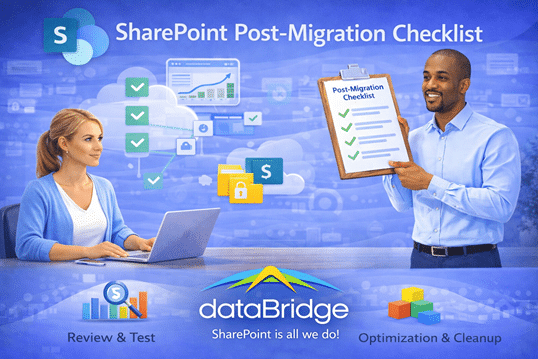
SharePoint Post-Migration Checklist
This SharePoint Post-Migration Checklist helps ensure your environment is usable, secure, governable, and ready to scale—not just technically complete.
Why Post-Migration Work Matters
Most SharePoint issues don’t appear during migration.
They surface weeks or months later, when:
- Users start creating content
- Teams grow organically
- Permissions expand
- Search and Copilot rely on real data
Post-migration work is where long-term value is either created or lost.
Phase 1: Stabilize the Foundation
Start by confirming your environment is stable, predictable, and understandable.
✅ Confirm Site Ownership
- Assign a clear owner to every site and Team
- Document ownership responsibilities
- Ensure owners understand their role
Ownership prevents sprawl and enables accountability.
✅ Review Site Structure
- Validate hub site associations
- Remove unnecessary sites created during migration
- Confirm sites align to business functions—not legacy systems
Structure should reflect how people work today, not how files lived yesterday.
✅ Validate Permissions
- Restore inheritance wherever possible
- Replace individual permissions with role-based access
- Remove unused or risky access
Predictable permissions reduce security risk and support Copilot accuracy.
Phase 2: Clean Up Migrated Content
Migration often brings more content than organizations expect—or need.
✅ Identify Redundant and Obsolete Content
- Remove duplicate files
- Archive outdated content
- Flag content with unclear ownership
Less content improves search, trust, and usability.
✅ Reduce Folder Dependency
- Flatten deep folder structures
- Replace folders with metadata where appropriate
- Simplify navigation
SharePoint works best when structure is intentional—not inherited.
✅ Standardize Naming Conventions
- Apply consistent site, library, and file naming
- Remove cryptic or legacy naming patterns
Consistency improves usability and discoverability.
Phase 3: Improve Search and Findability
Search success depends on structure—not luck.
✅ Define Metadata Strategy
- Identify key business metadata
- Apply content types where appropriate
- Train owners to use metadata consistently
Metadata turns SharePoint into a system of record—not a dumping ground.
✅ Validate Search Results
- Test common user search scenarios
- Confirm important content appears first
- Adjust structure or metadata as needed
Search trust drives adoption.
Phase 4: Establish Governance That Scales
Governance should guide behavior—not slow teams down. A practical SharePoint Governance Framework turns those standards into repeatable post-migration operating rules.
✅ Define Site and Team Creation Rules
- Clarify when new sites or Teams should be created
- Use templates or request workflows where appropriate
Clarity prevents sprawl without blocking collaboration.
✅ Document Ownership Responsibilities
- Define who manages access
- Define who maintains content
- Define who reviews sites over time
Governance works when responsibility is visible.
✅ Implement Lifecycle Management
- Set review and archival expectations
- Identify inactive sites
- Plan for cleanup before chaos starts
Lifecycle thinking keeps SharePoint sustainable.
Phase 5: Prepare for Copilot and Automation
AI amplifies both good and bad structure.
✅ Review Copilot Readiness
- Confirm permissions reflect intent
- Ensure authoritative content is easy to find
- Reduce noise and duplication
Copilot works best when SharePoint is clean and governed.
✅ Identify Automation Opportunities
- Look for manual processes tied to lists or libraries
- Introduce Power Automate where it adds value
- Avoid automating broken processes
Automation should simplify work—not reinforce bad design.
Phase 6: Drive Adoption and Confidence
Adoption doesn’t happen automatically after migration.
✅ Provide Clear Usage Guidance
- Explain when to use Teams vs SharePoint
- Define where authoritative content lives
- Set expectations for collaboration
Clarity reduces friction and frustration.
✅ Train Site Owners First
- Focus on owners before end users
- Teach structure, permissions, and governance basics
Strong owners create strong environments.
✅ Measure Adoption, Not Just Usage
- Monitor active sites and libraries
- Track search success and content growth
- Identify friction points early
Adoption signals health.
Common Post-Migration Mistakes This Checklist Prevents
- Treating migration as “done”
- Allowing permissions to spiral
- Letting ownership disappear
- Assuming search will fix itself
- Preparing for Copilot too late
The Bottom Line
A successful SharePoint migration moves content.
A successful SharePoint platform delivers clarity, trust, and long-term value.
Post-migration optimization is where SharePoint becomes:
- Easier to use
- Easier to manage
- Ready for AI
- Aligned to real work
How dataBridge Helps
dataBridge helps organizations:
- Stabilize SharePoint after migration
- Simplify structure and permissions
- Establish practical governance
- Prepare SharePoint for Copilot
- Drive real adoption—not just activity
If your migration is complete but SharePoint doesn’t feel right yet, that’s normal—and fixable.
Post-migration is where SharePoint actually starts working.
Organizations that need hands-on remediation after go-live often turn to SharePoint Migration Consulting to stabilize permissions, search, governance, and adoption.
Before vs After SharePoint Migration
Why Post-Migration Work Changes Everything

BEFORE: “We Migrated Everything”
What it looks like
- Flat or deeply nested folder structures
- Hundreds of sites with unclear purpose
- Individual permissions everywhere
- Duplicate and outdated files
- Teams used as file storage
- Search returns inconsistent results
What users experience
- “I don’t know where anything lives”
- “Which file is the final version?”
- “I’ll just email it instead”
- Low trust in SharePoint
- Copilot surfaces noise, not insight
Behind the scenes
- Lift-and-shift migration
- No governance or lifecycle rules
- Ownership unclear
- Permissions unmanaged
- Structure inherited from file servers
AFTER: “SharePoint Works for the Business”
What it looks like
- Clear site and hub structure
- Metadata-driven libraries
- Role-based permissions
- Defined ownership and lifecycle
- Teams aligned with SharePoint
- Predictable navigation and search
What users experience
- “I know exactly where to put this”
- “Search actually works”
- “Teams feels calmer and clearer”
- Confidence using SharePoint daily
- Copilot delivers relevant, trusted answers
Behind the scenes
- Post-migration optimization
- Governance embedded into design
- Ownership accountability
- Structure aligned to real workflows
- AI-ready content foundations
One Migration. Two Outcomes.
| Area | Before Optimization | After Optimization |
|---|---|---|
| Structure | Folder-heavy, inherited | Intentional, scalable |
| Permissions | Individual & inconsistent | Role-based & predictable |
| Ownership | Unclear or missing | Defined and accountable |
| Search | Unreliable | Trusted |
| Teams | Chaotic | Purposeful |
| Copilot | Noisy | Insightful |
| Adoption | Declines | Grows |
Download the Post Migration Checklist

THE SEARCH IS OVER
We're a Microsoft SharePoint partner - everything you need IS right here
For more information about how dataBridge can transform your business with improved corporate communication, collaboration, forms, workflows, and document management, contact us today.