Build a Secure, Compliant, and Easy-to-Use Healthcare Intranet
At dataBridge, we help healthcare providers design and implement modern SharePoint intranets that are secure, scalable, and aligned to how care teams actually work. Instead of focusing only on technology, we focus on structure, governance, and long-term platform health — the foundation of The dataBridge Way and our SharePoint Consulting Services approach.
Why Healthcare Organizations Struggle with Traditional Intranets
In our experience, healthcare intranets often fail for predictable reasons. While the platform may be capable, the underlying structure usually is not.
Organizations evaluating intranet strategy across Microsoft 365 often begin with a broader SharePoint intranet planning guide, which explains how architecture, governance, search, and document management influence long-term intranet success.
Common challenges include:
- Staff cannot quickly find policies or procedures
- Clinical teams rely on outdated documents
- Sensitive HR and compliance content feels risky
- Departments create siloed sites and Teams
- Governance exists on paper but not in practice
- Adoption drops after launch
As a result, the intranet becomes another place to store files instead of a trusted system that supports care delivery and operations.
Organizations facing these issues often benefit from a structured SharePoint Intranet & Portal Design engagement.
Healthcare organizations must also ensure that sensitive patient information remains protected while clinical teams collaborate effectively. Designing clear permission structures is essential in these environments, which is why many healthcare clients reference our Complete Guide to SharePoint Permissions when planning secure intranet architecture.
How dataBridge Designs Healthcare Intranets Differently
Many firms focus on launching SharePoint. We focus on making it sustainable.
Using The dataBridge Way, we design healthcare intranets that balance usability, compliance, and long-term governance. This approach strengthens healthcare information governance, supports least-privilege access, and improves overall HIPAA compliance posture. Least-privilege access is a security principle that ensures users only have access to the information necessary to perform their role.
Many organizations in regulated industries, especially healthcare, begin by reviewing real client success stories showing how Microsoft 365 governance and collaboration solutions were implemented.
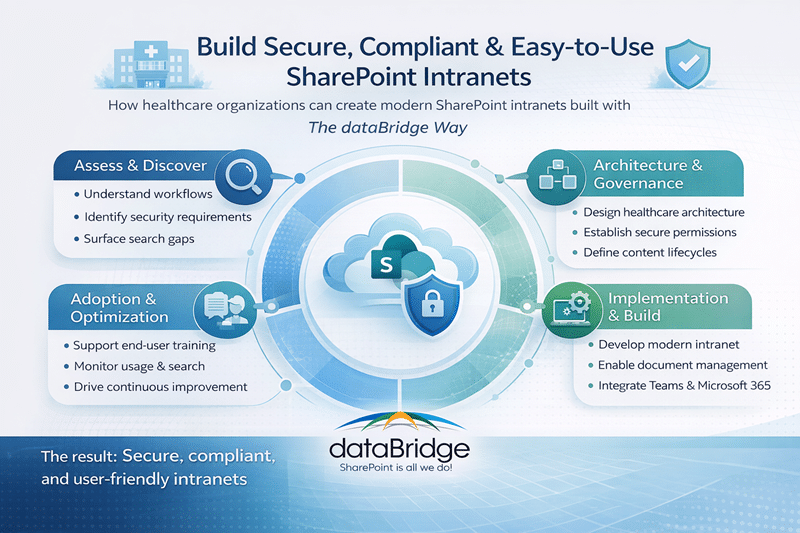
Our structured approach includes:
Assess & Discover
- Understand clinical and operational workflows
- Identify compliance and security requirements
- Map information flow across departments
- Surface search and findability gaps
Architecture & Governance
- Design healthcare-specific information architecture Records retention defines how long healthcare documents must be preserved to meet regulatory, legal, and operational requirements.
- Define content ownership and lifecycle
- Establish secure permission models
- Build scalable metadata and content types
(Organizations with mature environments often pair this with our SharePoint Governance Maturity Model.) Information governance refers to the policies, processes, and controls that ensure healthcare content is accurate, secure, properly retained, and accessible to the right users.
Implementation & Build
- Develop modern SharePoint intranet experience
- Configure role-based navigation
- Enable secure document management
- Integrate Teams and Microsoft 365 services
(Delivered through our SharePoint Design and Development methodology.)
Adoption & Optimization
Successful healthcare intranets require a deliberate intranet adoption strategy that aligns to real clinical and operational workflows.
- Support training and change management
- Monitor usage and search success
- Reinforce governance over time
- Continuously improve the experience
This structured model reduces risk and helps healthcare organizations maintain a trusted intranet long after go-live.
Organizations in healthcare often address intranet design, governance, and compliance architecture together. These initiatives are part of our broader SharePoint and Microsoft 365 consulting solutions approach.
Key Capabilities for Healthcare SharePoint Intranets
Healthcare environments have unique needs. Therefore, successful intranets must support both clinical and administrative use cases.
HIPAA-Compliant SharePoint Intranet Design for Healthcare
Healthcare organizations operate within strict regulatory frameworks. A structured SharePoint architecture for regulated industries ensures metadata classification, retention enforcement, and access controls align with compliance mandates.
Healthcare organizations require more than a standard intranet — they need a HIPAA-aligned environment that protects sensitive protected health information (PHI) while remaining usable for clinical and operational teams. Protected Health Information (PHI) includes any patient data that can identify an individual and must be secured under HIPAA regulations.
At dataBridge, we design SharePoint intranets within Microsoft 365 that embed security and governance from the start. This includes role-based access controls, structured information architecture, and lifecycle policies that reduce risk and support regulatory expectations. By aligning platform design to real healthcare workflows, organizations strengthen compliance posture, improve information trust, and maintain a secure, sustainable intranet over time.
Secure Policy and Procedure Management
We help healthcare organizations:
- Maintain a single authoritative source for policies
- Enforce version control and approvals
- Apply retention and compliance rules
- Improve policy search accuracy
This work is often supported by strong SharePoint Information Architecture & Metadata design. In healthcare environments, metadata is structured information that improves search accuracy, supports compliance, and helps staff quickly locate the correct policies and procedures.
Department and Service Line Hubs
Healthcare intranets must support diverse teams. We design structured hubs for:
- Nursing and clinical teams
- HR and employee services
- Compliance and quality
- IT and operations
- Executive communications
Each hub follows consistent governance while allowing appropriate flexibility through SharePoint Intranet & Portal Design best practices.
Employee Lifecycle and HR Integration
Healthcare HR teams often manage complex onboarding and credentialing workflows. We help streamline:
- New hire onboarding
- Policy acknowledgments
- Training coordination
- Role-based access provisioning
These improvements are frequently part of broader Microsoft 365 Consulting Strategy initiatives.
Copilot and AI Readiness
Healthcare leaders increasingly ask whether their content is ready for AI.
We prepare your environment through our Copilot Readiness for SharePoint approach by:
- Improving metadata consistency
- Securing sensitive content
- Establishing authoritative sources
- Reducing content sprawl
This helps ensure more accurate and trustworthy AI outcomes. Preparing your environment also improves Microsoft 365 security hygiene, strengthens data loss prevention (DLP) controls, and ensures Copilot accesses only authoritative healthcare content. Microsoft 365 compliance capabilities include tools such as retention policies, sensitivity labels, and data loss prevention (DLP) that help protect regulated healthcare content.
Why Healthcare Leaders Choose dataBridge
Healthcare organizations engage dataBridge when SharePoint is strategic — not incidental.
Our clients value that we:
- Lead with consulting, not just configuration
- Embed governance from the start
- Design for long-term sustainability
- Prioritize findability and trust
- Align Microsoft 365 to real healthcare workflows
Most importantly, we help organizations move from file storage to information confidence through our structured SharePoint Consulting Services methodology.
Organizations researching governance, collaboration architecture, and Microsoft 365 best practices can explore our SharePoint & Microsoft 365 Knowledge Center.