
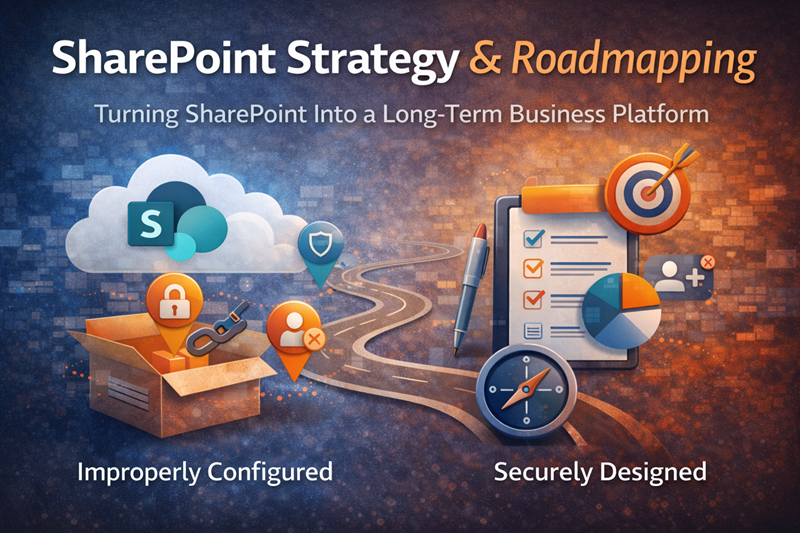
SharePoint Strategy & Roadmapping: Turning SharePoint Into a Long-Term Business Platform
Many organizations deploy SharePoint quickly. Far fewer deploy it intentionally.
As a result, SharePoint often starts strong but becomes fragmented over time. Sites multiply, permissions drift, and users lose confidence in where content belongs. Eventually, leaders ask why SharePoint feels difficult to govern, hard to adopt, and unprepared for automation or AI.
The root cause is rarely technology. Instead, it’s the absence of a clear SharePoint strategy and roadmap.
Why SharePoint Strategy Matters More Than Ever
SharePoint now sits at the center of Microsoft 365.
It underpins Microsoft Teams file storage, powers intranet experiences, supports Power Platform solutions, and feeds Microsoft Copilot. When SharePoint lacks structure, the entire ecosystem feels disjointed.
A well-defined SharePoint strategy clarifies why SharePoint exists, how it should be used, and what success looks like over time. This strategic clarity is a core component of SharePoint Consulting Services and a prerequisite for sustainable growth.
What Happens Without a SharePoint Roadmap
Without a roadmap, organizations often experience the same challenges.
Teams and sites sprawl without consistency. Departments design their own structures in isolation. Permissions become overly complex. Governance feels restrictive or is ignored altogether. User adoption declines as trust erodes.
Most importantly, the environment becomes difficult to support AI, automation, and analytics initiatives. These problems are symptoms of reactive decision-making rather than intentional design.
What a SharePoint Strategy Actually Defines
A strong SharePoint strategy answers practical questions before configuration begins.
A strong SharePoint strategy defines which business goals SharePoint supports and how departments will use it differently.
In addition, it establishes success metrics tied to outcomes, not features.
Finally, it provides direction for architecture, governance, and adoption.
This strategic foundation enables organizations to make consistent decisions across SharePoint Architecture & Governance, security, and long-term operations.
Architecture and Structure Come Next
Once strategy is clear, architecture decisions become easier.
A roadmap defines site and hub architecture, content organization patterns, and metadata direction. These decisions directly impact findability, reporting, and long-term usability.
Intentional structure also reduces the need for excessive customization and minimizes future rework. This approach aligns closely with SharePoint Information Architecture & Metadata best practices.
Governance Should Support, Not Block, Work
Governance is often misunderstood as control.
In reality, effective governance enables work by setting clear guardrails. A SharePoint roadmap defines ownership models, permission strategies, and lifecycle policies that scale as adoption grows.
When governance aligns with how people actually work, compliance improves and risk decreases. This balance is essential to SharePoint Security & Compliance and long-term platform trust.
Adoption Is Planned, Not Assumed
Even the best-designed SharePoint environment fails without adoption.
A roadmap addresses training, communication, and change management early. It explains not just how to use SharePoint, but why it benefits users’ daily work.
This proactive approach strengthens adoption and reduces resistance. It is a cornerstone of SharePoint Adoption & Change Management and a key driver of long-term success.
Strategy Is the Foundation for Copilot and AI
Microsoft Copilot depends on structured, governed content.
Without a SharePoint strategy, Copilot surfaces inconsistent or misleading results. Permissions issues become more visible, and trust in AI declines quickly.
Organizations preparing for AI-driven experiences must start with strategy, not prompts. That preparation is central to Copilot Readiness for SharePoint and begins with intentional roadmapping.
SharePoint Strategy Evolves Over Time
A roadmap is not a one-time document.
Instead, it serves as a living guide that adapts as business needs change. It supports continuous improvement, new capabilities, and platform evolution without disruption.
This long-term mindset separates tactical implementations from strategic platforms.
The Bottom Line
SharePoint delivers the most value when guided by strategy, reinforced by governance, and supported by adoption.
Organizations that invest in SharePoint Strategy & Roadmapping reduce risk, improve usability, and create a foundation for automation, analytics, and AI.
In short, SharePoint should not grow by accident. It should evolve by design.
That’s how SharePoint becomes a true business platform—one built for today and ready for what’s next.
Contact us to schedule a strategy session
For more insights on governance, architecture, and Microsoft 365 strategy, explore our SharePoint knowledge center.
Organizations implementing these improvements often engage our SharePoint and Microsoft 365 consulting solutions.
Related Resources
- The Complete Guide to Building a Modern SharePoint Intranet
- Industry-Specific SharePoint Intranet Solutions
- Healthcare SharePoint Intranet Services
- Financial Services SharePoint Intranet Services
- Manufacturing SharePoint Intranet Services
- Professional Services SharePoint Intranet Services
- Education SharePoint Intranet Services
- Government SharePoint Intranet Services
- Construction SharePoint Intranet Services
Reviewed By