Governance Is Usually Ignored Until the Business Feels It
Power Platform governance often gets framed as an IT exercise.
That is one reason it gets delayed.
Teams want speed. Departments want quick wins. Leaders want to remove friction. So organizations start building apps, automations, and lightweight solutions without spending much time on standards, ownership, or environment strategy.
At first, that can feel productive.
A few processes improve. A handful of manual tasks disappear. Someone builds an app the business likes. A team launches a workflow that saves time. Early momentum creates the impression that governance can wait.
Then the environment grows.
More makers build more solutions. Flows connect to more data. Apps start solving important operational problems. Ownership gets fuzzy. Environments become inconsistent. Security questions get harder to answer. Support becomes reactive.
What looked like agility starts turning into risk.
That is why Power Platform Governance & Security should not be treated as a technical afterthought. It is a business design decision. The longer that decision is postponed, the more expensive the cleanup becomes.
A simple truth tends to hold up here: speed without structure is not agility. It is deferred complexity.
This article is a thought-leadership post about the business impact of weak Power Platform governance. For the service page, use Power Platform Governance & Security. For broader planning across apps, workflows, forms, adoption, and Microsoft 365 automation, use Microsoft Power Platform Consulting.
Why This Is Not Just an IT Problem
Poor governance rarely stays inside IT.
The effects usually surface in operations, compliance, finance, and leadership first.
When a workflow breaks and no one knows who owns it, the business feels that disruption. When two departments build different apps for the same task, the business pays for duplication. When sensitive data moves through connectors no one reviewed carefully, the business carries the exposure. When reporting becomes inconsistent because logic lives in too many places, leaders lose confidence in the numbers.
That is not an IT inconvenience. That is operational drag.
In our experience, the organizations that struggle most with Power Platform governance are not struggling because the tools are weak. They are struggling because critical business decisions were never made clearly enough at the start.
Questions such as these often go unanswered for too long:
- Who is allowed to build what?
- Which environment should be used for which type of solution?
- When does a personal productivity app become a shared business application?
- Who owns support after launch?
- How are connectors, data movement, and change control managed?
- What happens when the original creator leaves?
These are governance questions, but they are also business continuity questions.
That is why the strongest Power Platform environments are usually tied to broader strategy, not isolated tool decisions. They align with Microsoft Power Platform Consulting that treats apps, flows, data, and Microsoft 365 structure as part of one connected operating model.
What Poor Power Platform Governance Actually Costs the Business
The cost of weak governance is not always obvious on day one.
That is part of the problem.
The first app might work. The first few flows might help. The early wins can be real. But as the environment expands, the hidden costs start stacking up.
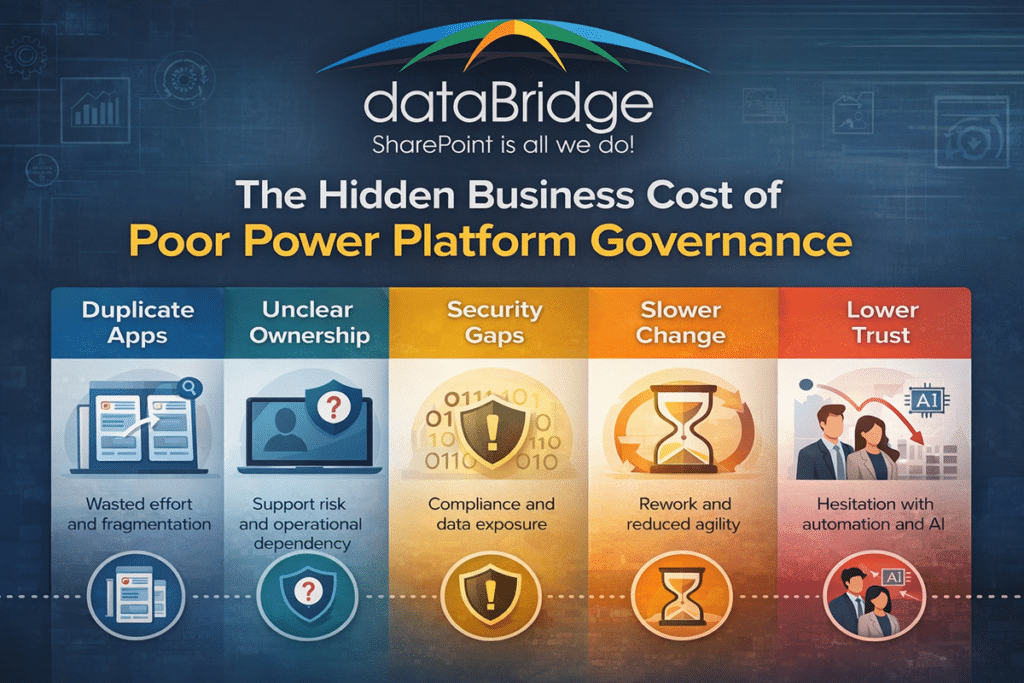
1. Duplicate solutions and wasted effort
Without clear governance, different teams often solve the same problem in different ways.
One department builds a request app. Another builds a slightly different version. A third team creates a flow to work around both. Now the organization has three versions of the same business logic, each with different owners, assumptions, and maintenance needs.
That is not innovation. It is fragmentation.
2. Support risk and operational dependency
A surprising number of business-critical solutions are still tied too closely to one person.
When that maker changes roles, leaves the company, or simply moves on to other priorities, support becomes guesswork. Small issues take longer to fix. Changes feel risky. Confidence drops.
Governance should make solutions easier to inherit, not harder.
3. Security and compliance exposure
Weak governance often shows up in connector sprawl, inconsistent environment use, unclear access models, and accidental overreach with data.
This is where governance stops being abstract.
If an organization cannot explain how data moves, who can access it, and where sensitive logic lives, the business is already carrying more risk than leadership probably realizes.
4. Slower change, not faster change
Many teams avoid governance because they believe it slows delivery.
In reality, unmanaged environments often become slower over time.
Why? Because every new request has to navigate confusion. People stop trusting what already exists. Teams rebuild instead of improve. Changes require detective work. A platform that was supposed to create momentum starts creating hesitation.
Good governance does not remove speed. It protects sustainable speed.
5. Lower trust in automation and AI
Trust is easier to lose than to rebuild.
When users see inconsistent apps, broken flows, unclear ownership, or strange results from AI-assisted experiences, they stop assuming the platform is reliable. Adoption suffers. Executive confidence softens. Future investments become harder to justify.
That is one reason strong governance should connect directly to Power Platform Adoption & Change Management. Adoption is not just training people to use tools. It is helping them trust the environment behind those tools.
The business impact of weak Power Platform governance usually shows up in a few repeatable patterns.